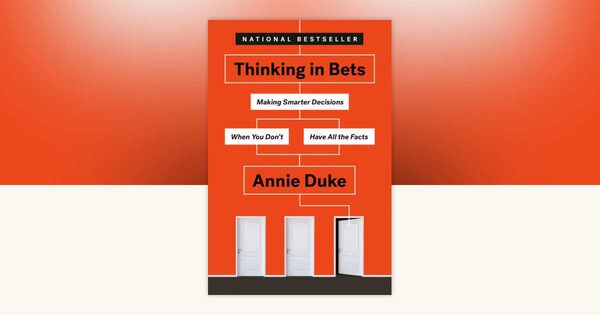
Thinking in Bets Review (2026): Annie Duke’s Playbook for Better Decisions Under Uncertainty
If you make decisions under uncertainty, at work, with money, or in everyday life, Thinking in Bets is one of the more useful mindset books you can buy. Annie Duke’s core argument is simple: stop judging choices only by the outcome, and start judging them by the quality of your reasoning at the time you made them. That sounds obvious, but in practice it is hard, and the book is good precisely because it turns that idea into habits you can actually use.
Quick verdict: this is a strong pick for readers who want better judgment, less hindsight bias, and a more honest way to evaluate wins and losses. It is not a dense statistics textbook, and that is part of its appeal.
Top pick on Amazon: Check Thinking in Bets on Amazon here
Affiliate link. Prices and formats can change.
TL;DR
Thinking in Bets helps you separate decision quality from result quality. Annie Duke uses poker, business decisions, and everyday examples to show why smart people still make bad calls, why lucky outcomes can fool us, and how to get better by thinking in probabilities instead of absolutes. If you want a practical book about decision-making without a lot of academic drag, this is an easy recommendation.
Who it’s for
- Managers, founders, and operators making calls with incomplete information.
- People who replay decisions in their head and judge themselves too harshly based on what happened next.
- Readers interested in judgment, psychology, risk, forecasting, or behavior change.
- Teams that want better post-mortems and less blame-driven hindsight.
Who should skip it
- Readers who already spend a lot of time with forecasting, probabilistic reasoning, or decision science and want something more technical.
- People who strongly dislike poker metaphors. Duke uses them often, and for some readers that will wear thin.
- Anyone looking for a memoir or inspirational self-help book. This is more practical than personal.
Pros
- Very practical: the ideas translate well into work, money, and everyday choices.
- Readable: Duke explains uncertainty clearly without making the book feel academic.
- Useful mental models: expected value, calibration, decision journals, and pre-mortems all show up in actionable ways.
- Good for teams: the book is unusually helpful if you lead people and want better decision culture.
Cons
- Poker framing is everywhere: I think it works, but some readers will find it repetitive.
- Less useful for values-driven choices: not every life decision should be reduced to odds and expected value.
- Not deeply technical: if you want a rigorous treatment of Bayesian reasoning or forecasting methods, this is not that book.
What we looked at
For this review, I looked at the book’s core argument, the practical tools it teaches, how well it translates outside poker, how readable it is for a general audience, and whether the advice holds up in real work situations where outcomes are noisy and delayed. I also checked the publisher description and the broader decision-making context around concepts like pre-mortems, calibration, and outcome bias.
What to look for before you buy
- Your tolerance for metaphor: if poker examples help ideas stick, this book will land well. If they annoy you, it may feel overextended.
- Your goal: buy it if you want a practical mindset upgrade, not if you want an advanced research-heavy text.
- Your use case: this book is especially worthwhile if you make repeated decisions, manage other people, invest, build products, or review outcomes after the fact.
- Your format preference: this title works well in print, Kindle, or audiobook because the concepts are portable and discussion-friendly.
What the book is really arguing
The strongest idea in Thinking in Bets is that a good decision can lead to a bad outcome, and a bad decision can lead to a good outcome. That sounds basic, but most people, and plenty of organizations, still reward luck and punish well-reasoned misses. Duke’s argument is that this trains terrible habits. If you only learn from outcomes, you will end up overconfident after lucky wins and too cautious after unlucky losses.
Her solution is to think in probabilities. Instead of saying “I know,” you start saying “I’m 70% confident.” Instead of treating a setback like proof of failure, you ask whether the original process was sound. Over time, that shift makes you calmer, more accurate, and much easier to work with.
Best ideas in the book
1. Outcome bias is everywhere
Duke explains outcome bias well because she has lived in a field where luck and skill are tightly intertwined. That experience gives the book credibility. In business, careers, health habits, and investing, the same pattern appears constantly. People reverse-engineer the result and pretend it was obvious. The book is useful because it pushes back on that instinct hard.
2. A decision journal is more powerful than most people expect
One of the best practical takeaways is to write down what you believed before the outcome arrives. That can be a short note on what you chose, what facts you had, what assumptions you made, and what would change your mind. Later, when memory tries to rewrite the story, you have a cleaner record. It is one of the simplest upgrades in the book, and probably the highest return one for most readers.
3. Pre-mortems improve judgment fast
The pre-mortem idea, imagine failure first, then ask what caused it, is easy to use and immediately helpful. Teams often avoid honest criticism until after a project goes wrong. Duke’s framing helps surface risks earlier, when they are still cheap to fix.
4. Better disagreement makes better decisions
The book is also good on the social side of judgment. Duke argues that you need people around you who care more about accuracy than ego. That matters. Most bad decisions are not just individual failures of logic. They are reinforced by group dynamics, status games, and the desire to sound certain. I liked this part because it makes the book more useful in real organizations, not just in your own head.
Where it is strongest, and where it is weaker
Where the book is strongest is in turning a smart idea into a repeatable practice. It is not just “be less biased.” It is “here are specific habits that make you less biased.” That makes it more durable than a lot of airport-business-book advice.
Where it is weaker is in areas where decisions are not mainly about uncertainty, but about values. Some choices are not really bets. They are statements about identity, ethics, relationships, or tradeoffs you cannot cleanly quantify. Duke is sharp on the uncertainty problem, but that does not cover every category of hard decision.
How it compares to similar books
If you liked Clear Thinking by Shane Parrish, this book makes a strong companion. Clear Thinking focuses more on avoiding predictable mistakes before pressure takes over. Thinking in Bets is more about uncertainty, probabilities, and learning from results without fooling yourself.
If you want another practical book on making better tradeoffs with limited time and resources, you might also like Die With Zero. It is a different category, but both books are useful because they force you to think more deliberately instead of defaulting to the loudest instinct in the room.
Buying options on Amazon
Sources
- Annie Duke, Thinking in Bets: Making Smarter Decisions When You Don’t Have All the Facts.
- Penguin Random House book page: Thinking in Bets by Annie Duke.
- General decision-making concepts discussed in the book, including outcome bias, pre-mortems, and calibration.
FTC disclosure: This post contains Amazon affiliate links. If you buy through these links, Must Grab That may earn a small commission at no extra cost to you.