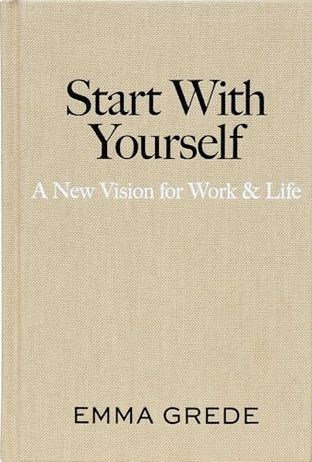
Start With Yourself Review (2026): Emma Grede on Ambition, Self-Trust, and Doing the Work
Disclosure: This review contains Amazon affiliate links. If you buy through our links, MustGrabThat may earn a small commission at no extra cost to you.
Quick take: Start With Yourself is a timely business-and-life reset from Emma Grede, the entrepreneur and investor associated with Good American, SKIMS, and Shark Tank. It is not a dense operations manual or a magic confidence hack. Its value is in the way it turns ambition inward first: before you chase the next opportunity, promotion, brand idea, or money goal, you need clearer standards, stronger self-trust, and a more honest picture of what you will actually do consistently.
Check Start With Yourself by Emma Grede on Amazon
Why this book is timely right now
Start With Yourself landed on the New York Times Business Books best-seller list as a new-this-week title, which makes it a strong fit for a weekly MustGrabThat book pick: it is current, visible, and aimed at readers who want practical self-improvement with a career, money, and decision-making angle. It also fits the site’s existing Books coverage, especially if you have liked reviews such as Future Rich Person, The 5 Types of Wealth, or Atomic Habits.
The reason this one stands out is that it arrives at a moment when a lot of readers are exhausted by generic “be your best self” advice. People do not need another poster that says believe bigger. They need help separating useful ambition from performative ambition. Grede’s pitch, at least as this review reads it, is that success gets much less mysterious when you stop treating confidence as a personality trait and start treating it as a byproduct of choices: how you prepare, what standards you keep, what rooms you enter, and how often you follow through when nobody is clapping.
What Start With Yourself is about
The core idea is simple: if you want better outcomes, begin with the person making the decisions. That may sound obvious, but it is the part many career and wealth books rush past. They jump straight to networking, scaling, negotiating, investing, leadership frameworks, or productivity systems. Those topics matter, but they work best when they sit on top of a more reliable base: self-knowledge, personal standards, resilience, and the ability to act before conditions feel perfect.
Grede’s angle is shaped by entrepreneurship. She is writing as someone whose public brand is tied to building consumer companies, working around celebrity-driven brands, and pitching ideas in rooms where persuasion matters. That gives the book a different flavor from a purely academic self-help title. It is more about agency than theory. The useful question running underneath the book is: what would change if you stopped waiting to be picked and started behaving like someone responsible for the next move?
Readers should expect a mix of mindset, professional reflection, and practical prompts. The book appears designed for people who know they want more—more career momentum, more business confidence, more money competence, more ownership of their choices—but who keep getting stuck in comparison, hesitation, overthinking, or vague planning. It is less about one perfect tactic and more about building a durable operating system for showing up.
Who this book is for
Start With Yourself is best for early- to mid-career readers, aspiring founders, side-hustle builders, creators, professionals who want more ownership, and anyone trying to rebuild confidence after a stall. If you are the kind of person who bookmarks business podcasts, saves clips about discipline, buys a notebook in January, and then gets frustrated when motivation fades, this is squarely in your lane.
It may also be useful for readers who liked the practical, non-shaming tone of money and life books such as You Deserve to Be Rich but want something more career- and identity-focused. Grede’s public story gives the book an aspirational edge, yet the strongest material is likely to be the parts that translate ambition into repeated behavior: how you define your standards, how you recover from rejection, and how you decide what kind of person you are becoming while you pursue the goal.
Buy it if you want a motivational business book with enough practical reflection to push you into action. It is especially relevant if your problem is not that you lack information, but that you do not yet trust yourself to act on the information you already have.
Who should skip it
Skip this book if you want a technical manual on company building, venture finance, supply chains, hiring, or brand operations. A reader looking for spreadsheets, case studies, market-sizing templates, or step-by-step startup mechanics may find the tone too personal. Likewise, if you dislike celebrity-adjacent business books or prefer heavily sourced behavioral science, you may want a more research-driven pick.
It may also be less useful if you are already deep into the self-development genre and have recently read several books on confidence, habits, and identity. The main ideas will not all feel brand new. The question is whether Grede’s voice, examples, and framing make the familiar advice land at the right time. For some readers, that is enough. For others, it may feel like a polished reminder rather than a revelation.
Strengths: where the book is likely to help
The first strength is accessibility. Business books can become weirdly abstract, especially when they are written by people who have already succeeded. Start With Yourself seems positioned as a more approachable bridge between inspiration and execution. The title itself is a useful filter: before blaming the market, your boss, the economy, the algorithm, or your lack of connections, what can you clarify and control?
The second strength is that it treats confidence as something earned. That matters. A lot of advice tells people to “be confident” as if confidence is a switch. In real life, confidence usually comes from evidence. You kept a promise. You prepared. You practiced. You survived an awkward conversation. You made a decision and learned from the result. A book that repeatedly points readers back to self-trust can be genuinely helpful, because self-trust is often the missing link between consuming advice and doing anything with it.
The third strength is fit. MustGrabThat readers tend to respond to books that are actionable without being punishing. The Let Them Theory works for many people because it gives a memorable phrase to a common emotional problem. Start With Yourself has a similar advantage: the phrase is simple enough to remember when you are making a decision. Before chasing the next shortcut, start with your standard. Before asking for more, start with what you are willing to practice. Before copying someone else’s path, start with your own values, energy, and constraints.
Weaknesses and caveats
The main caveat is that readers should not expect every chapter to reinvent the genre. Books built around confidence, ownership, and ambition often overlap with common self-help territory: mindset, preparation, resilience, personal responsibility, and persistence. If you have read widely in business and personal development, you will recognize some of the terrain.
Another caveat is that advice from highly successful founders can be hard to translate. The distance between a reader’s daily life and a public entrepreneur’s career can feel large. The best way to use the book is not to copy Grede’s path; it is to extract the questions that scale down to your own week. What opportunity are you avoiding because you want certainty first? What standard do you say you have but do not actually practice? What relationship, habit, or assumption is making your goal harder than it needs to be?
Finally, this is not a substitute for tactical learning. If your goal is to launch an online store, negotiate a raise, clean up debt, or build a repeatable content system, you will still need specific tools. Think of Start With Yourself as the book that helps you become the kind of person who uses those tools instead of endlessly collecting them.
Buying formats and how to choose
The hardcover is the obvious choice if you like marking up business books, dog-earing prompts, or keeping a shelf of titles you revisit when you need a reset. The Kindle edition makes sense if you read in short sessions and want highlights you can export or search later. The audiobook may be the strongest format for readers who want the motivational tone during commutes, walks, errands, or gym sessions.
If you are unsure, choose based on how you actually absorb books. For reflective material, a physical or Kindle copy is usually better because you can pause and write. For momentum, audio often wins. Either way, the best return comes from treating the book as a workbook: after each useful idea, write down one action small enough to complete this week.
Practical ways to use the book
Do not read this like a biography and wait to be inspired. Read it with a pen. At the end of each chapter, ask three questions: what am I avoiding, what standard would make the next decision easier, and what is one visible action I can take within 48 hours?
For career readers, that action might be requesting feedback, updating a portfolio, pitching a project, or applying for a role that feels slightly beyond your current confidence. For money-minded readers, it might be setting a weekly money meeting, automating savings, or finally reading the investing or budgeting book you keep postponing. For aspiring founders, it might be testing a small offer before overbuilding the perfect brand.
The point is to convert identity into evidence. “I am becoming someone who follows through” only becomes believable when you collect proof. That is where a book like this can help if you use it actively.
Final verdict: should you buy Start With Yourself?
Verdict: worth grabbing for readers who want a current, motivational business book with a practical self-trust angle. Start With Yourself is not the most technical book you will read this year, and it will not replace a specialized guide on money, entrepreneurship, leadership, or habits. But it has a strong timely hook, a clear audience, and a useful central reminder: your next level is probably less about finding one more secret and more about becoming honest, prepared, and consistent enough to use what you already know.
If you are in a season where ambition feels messy—too many ideas, too much comparison, too many half-started plans—this book is a sensible pick. Read it for the prompts, not just the inspiration. Then choose one standard, one action, and one promise to keep this week.
See current price and formats for Start With Yourself on Amazon