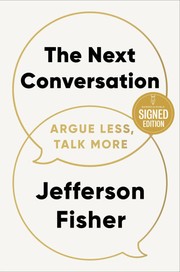
The Next Conversation Review (2026): Jefferson Fisher’s Practical Guide to Better Hard Talks
MustGrabThat may earn a commission if you buy through links in this article. As an Amazon Associate, we earn from qualifying purchases. Prices and availability can change.
Quick take: The Next Conversation by Jefferson Fisher is a practical communication book for people who want fewer circular arguments, cleaner boundaries, and calmer words when a conversation starts to heat up. It is not a dense academic text or a therapy manual; it is a field guide of phrases, reframes, and small conversational moves you can actually remember under pressure.
Check the current price and formats on Amazon: The Next Conversation by Jefferson Fisher.
Why this book is timely right now
Communication books tend to become popular when they promise something bigger than “say it better.” The reason The Next Conversation feels especially timely is that it addresses a problem almost everyone recognizes: we have more ways to communicate than ever, but fewer people feel confident when the conversation is tense, personal, or emotionally loaded. Work chats blur into home life. Text threads turn into misunderstandings. Family conversations get political. Even simple feedback can feel like a trap.
Open Library metadata lists The Next Conversation as a 2025 release by Jefferson Fisher, and it has been easy to understand the interest around it: Fisher’s public persona is built around concise, repeatable advice for arguing less and communicating with more confidence. That makes the book a natural fit for MustGrabThat’s Books section, where the best picks are not just interesting reads but practical upgrades for daily life. If you liked the useful, behavior-focused side of books such as Never Split the Difference, The Courage to Be Disliked, or Slow Productivity, this sits in a similar “use it this week” lane.
What The Next Conversation is about
The core promise of the book is simple: your next conversation can be better than your last one if you stop trying to win every exchange and start managing tone, timing, clarity, and emotional control. Fisher’s approach is less about grand speeches and more about short, usable lines that keep a discussion from becoming a fight. The book’s strength is in making communication feel less mysterious. Instead of telling readers to “be assertive” or “listen actively” in the abstract, it gives them language they can borrow when their own words disappear.
That matters because hard conversations rarely fail because someone lacks a perfect argument. They fail because the first sentence lands wrong, the reply gets defensive, and both people start protecting themselves instead of solving the issue. Fisher focuses on the small hinge moments: how to disagree without escalating, how to hold a boundary without sounding cruel, how to respond when someone is baiting you, and how to pause before you donate your nervous system to someone else’s mood.
The result is a book that reads like a communication toolkit. It is not trying to replace professional counseling, conflict mediation, or a full negotiation course. It is trying to give ordinary readers better default settings: fewer reactive replies, fewer apology spirals, fewer “I should have said…” regrets, and more sentences that are calm enough to be heard.
Who this book is for
The Next Conversation is best for readers who want practical scripts without feeling like they are memorizing corporate dialogue. If you have ever reread a text five times before sending it, avoided a direct conversation because you did not want to sound mean, or left a meeting wishing you had pushed back more clearly, this book is probably in your lane.
It is especially useful for people who deal with emotionally loaded conversations in everyday settings: managers giving feedback, partners trying to discuss recurring friction, adult children navigating family boundaries, small-business owners handling customer tension, teachers and coaches correcting behavior, or anyone who freezes when a conversation becomes confrontational. The book is also a good fit for readers who prefer short chapters, memorable phrases, and advice that can be applied in one conversation rather than after months of study.
There is a broader self-improvement appeal too. Like many modern practical nonfiction books, this is really about agency. Fisher is not promising that you can control other people. He is arguing that you can control your side of the exchange: your pace, your wording, your willingness to clarify, your ability to stop a conversation from dragging you into a version of yourself you do not respect.
Who should skip it
Skip The Next Conversation if you want a heavily researched academic book with footnotes on linguistics, psychology, and conflict theory. The appeal here is accessibility, not scholarly depth. Readers who already have deep training in therapy, mediation, hostage negotiation, nonviolent communication, or executive coaching may find some of the advice familiar.
You should also skip it if you are looking for a magic phrase that can fix an unsafe, abusive, or chronically bad-faith relationship. Better communication can improve many situations, but it cannot make another person respectful, honest, or regulated. Some conversations do not need better wording; they need distance, documentation, outside help, or a hard boundary. The book is strongest when both sides have at least some capacity to engage. It is less useful when the other person is committed to manipulation or escalation.
What works best
The best thing about Fisher’s approach is that it respects the reality of pressure. Most people do not become their wisest selves when they feel accused, dismissed, or embarrassed. A good communication book has to work when your pulse is up and your vocabulary is down. The Next Conversation understands that. Its most useful ideas are the ones that help you buy a second, lower the temperature, or choose a sentence that does not pour fuel on the moment.
The second strength is tone. Fisher’s advice usually aims for firm without theatrical. That is a hard balance. A lot of assertiveness advice online drifts into performance: the perfect comeback, the devastating boundary, the line that makes everyone clap. Real life is messier. Most of us are not trying to dominate a conversation; we are trying to keep dignity while staying connected enough to solve the problem. This book is more useful when read through that lens. It is about clean communication, not verbal combat.
The third strength is that the book encourages readers to be specific. Vague communication creates room for resentment. “You never listen” invites a fight. “When I’m explaining the schedule and you pick up your phone, I feel like we’re not actually deciding anything” gives the conversation a handle. Fisher’s advice repeatedly points back to clarity: say what you mean, reduce the accusation, and make the next step easier to understand.
Weaknesses and caveats
The biggest caveat is that script-based books can make hard conversations feel cleaner than they are. A good line can help, but it does not guarantee a good response. If the other person is tired, defensive, avoidant, or determined to misunderstand you, even a well-chosen sentence may not land. Readers should treat Fisher’s phrases as tools, not spells.
There is also a risk of over-smoothing. Some readers may interpret calm communication as always staying measured, always being gracious, and always making the other person comfortable. That is not the goal. The point of regulating your tone is not to shrink yourself; it is to stay clear enough to say the true thing. If you are a chronic people-pleaser, read this book with that distinction in mind. Calm is useful. Self-erasure is not.
Finally, because Fisher’s style is intentionally accessible, readers looking for a deep framework may want to pair this with a more comprehensive book on negotiation, boundaries, or relationships. For example, Never Split the Difference is stronger on tactical listening and negotiation pressure, while The Next Conversation is more approachable for everyday interpersonal friction.
How to get the most from it
Do not read this like a one-and-done motivational book. Read it with a notes app open. When a phrase or move sounds useful, rewrite it in your own voice. The goal is not to sound like Jefferson Fisher; the goal is to have a few reliable lines ready before you need them.
A practical way to use the book is to pick three situations: one at work, one at home, and one with a difficult recurring personality in your life. For each, write down a better opening sentence, a boundary sentence, and an exit sentence. For example: “I want to talk about this, but I don’t want to do it while we’re both heated.” Or: “I’m not ignoring your point; I’m trying to separate the issue from the tone.” You may never use the exact wording, but the rehearsal makes it more likely that you will choose clarity instead of reflex.
It also helps to read the book slowly. Communication advice gets more valuable when you test it quickly. Read a chapter, try one idea in a low-stakes conversation, and notice what changes. Did you interrupt less? Did the other person soften? Did you state the boundary sooner? Did you avoid sending the text that would have made the whole thing worse? That feedback loop is where the book earns its keep.
Buying formats: hardcover, Kindle, and audiobook
For most readers, the best format depends on how you plan to use it. The hardcover or paperback is useful if you like underlining scripts and flipping back to specific sections before a conversation. The Kindle edition is convenient if you want to highlight lines and search for them later. The audiobook can be a strong choice for this particular topic because tone matters; hearing communication advice aloud can make the phrasing easier to remember and adapt.
If you are buying it as a practical household or workplace reference, the physical version has the edge. If you are buying it for a commute or want to absorb the general mindset, audio may be more natural. Either way, check the current edition and format options before buying: The Next Conversation on Amazon.
Final verdict
The Next Conversation is worth grabbing if you want a practical, low-friction communication upgrade. Its value is not that every sentence will be new; it is that Fisher packages the advice in a way readers can actually use when the conversation gets uncomfortable. The book is clear, memorable, and grounded in everyday scenarios rather than abstract ideals.
The best readers for it are people who want to be more direct without becoming harsh, calmer without becoming passive, and more confident without turning every disagreement into a contest. It will not solve every relationship problem, and it should not be treated as a replacement for deeper help when a situation is unsafe or chronically toxic. But as a practical guide to making the next hard conversation a little less messy, it earns a strong recommendation.
Bottom line: buy it if you want scripts and principles you can apply quickly. Skip it if you need academic depth or a full conflict-resolution system. For most readers, this is a useful bookshelf addition because the next conversation is rarely theoretical—it is probably already waiting in your inbox, your kitchen, or your next meeting.