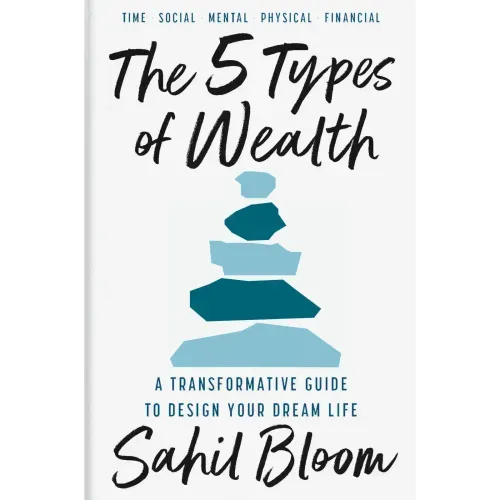
The 5 Types of Wealth Review (2026): Sahil Bloom’s Broader Scoreboard for a Better Life
TL;DR: The 5 Types of Wealth by Sahil Bloom is a polished, highly readable personal-development book built around a useful idea: money matters, but a good life also depends on time, relationships, mental clarity, and physical health. It is strongest as a reset for ambitious people who have optimized for income and status while quietly underinvesting in everything else. It is weaker if you want rigorous original research, sharper argumentation, or a system that goes much deeper than a well-packaged framework. Still, for the right reader, it is practical, motivating, and worth reading.
See The 5 Types of Wealth on Amazon
What this book is about
Most “wealth” books still orbit the same old center of gravity: earn more, save more, invest better, retire earlier. Bloom argues that this scoreboard is too narrow, and that a life can look financially successful while being poor in more important ways. His alternative is a five-part model of wealth: Time Wealth, Social Wealth, Mental Wealth, Physical Wealth, and Financial Wealth. The core pitch is simple but sticky: if you measure life using a broader scoreboard, you make better decisions and build a more durable version of success.
That idea is not totally new, but Bloom packages it extremely well. He writes with the tone of a smart operator who wants to shake readers out of autopilot without sounding academic. The result is a book that reads quickly, lands emotionally, and gives the reader enough reflection prompts and practical reframes to make behavior change feel possible instead of abstract.
Who it’s for
- Ambitious professionals who are doing “well” on paper but feel stretched, distracted, or oddly unsatisfied
- Readers who like self-improvement books that blend stories, frameworks, and immediate action steps
- Anyone in a transition phase, such as a career pivot, new parenthood, burnout recovery, or midlife recalibration
- Fans of authors like Morgan Housel, Arthur Brooks, Oliver Burkeman, or Ali Abdaal
Who should skip it
- Readers who want dense evidence, footnote-heavy argument, or deep original theory
- People allergic to modern “life design” language and motivational storytelling
- Anyone expecting a pure money book with detailed investing or budgeting tactics
Key ideas in the book
The strongest concept here is the scoreboard metaphor. Bloom’s point is that people drift toward whatever they measure, whether that is compensation, title, followers, or visible productivity. If your metric is incomplete, your life may become incomplete in the same direction. By expanding the scoreboard, the book encourages readers to ask better questions: Do I control my time? Do I have deep relationships? Is my mind steady? Is my body capable? Do I have enough money to support the rest?
The five wealth categories themselves are intuitive. Time Wealth is about autonomy and attention, not just spare hours. Social Wealth focuses on the quality and depth of relationships. Mental Wealth concerns purpose, self-awareness, and inner alignment. Physical Wealth deals with energy, strength, and long-term health. Financial Wealth matters too, but as a tool that supports the others rather than replacing them.
Another recurring idea is that “more” is not always the answer. Bloom pushes readers toward defining “enough,” which is useful because vague ambition often turns into permanent dissatisfaction. The book is at its best when it nudges the reader away from default settings and toward intentional tradeoffs. That is a message many high-performers need to hear.
What it gets right
First, it gets the emotional problem exactly right. Plenty of people have built impressive-looking lives that feel thin in private. Bloom clearly understands that modern achievement culture can produce a strange kind of poverty: calendar chaos, shallow relationships, low-grade anxiety, poor health, and a constant sense of postponing real life until later.
Second, the framework is memorable. Whether or not every category feels groundbreaking, it is easy to remember and therefore easy to use. That matters. A framework that sticks in your head has a better chance of influencing actual choices than a more sophisticated one you forget after a week.
Third, the book is constructive rather than cynical. It does not merely criticize hustle culture, it offers a replacement lens. The tone stays forward-looking and practical, which makes the material more useful for readers who want to change behavior now, not just nod along with critique.
What it gets wrong, or at least oversimplifies
The book’s clean structure is also its limitation. Like many broad self-development books, it sometimes compresses messy life realities into elegant frameworks. Tradeoffs between money, family, health, and purpose are real, but they are not always solved by clearer values alone. Structural constraints, debt loads, caregiving burdens, and plain bad luck can make “design your life” advice feel easier said than done.
It also leans heavily on synthesis and packaging. Bloom is a strong curator and communicator, but readers who consume lots of psychology, productivity, and behavior-change writing will recognize familiar themes. That does not make the book bad, but it does mean its value is more in integration and motivation than in radical originality.
Finally, some readers may want more friction, more counterargument, and more evidence density. The prose is accessible by design, which is a strength for reach, but it occasionally comes at the cost of depth.
Practical takeaways
- Audit your current scoreboard. Write down what you are actually measuring in life right now. Income? Inbox zero? Praise? Steps? Family dinners? If the scorecard is narrow, your life probably is too.
- Define “enough” financially. A rough target, even if imperfect, is often more useful than endless vague accumulation.
- Protect time before optimizing productivity. More apps and better routines do not help much if your calendar belongs to everyone else.
- Treat relationships as a build, not a leftover. Bloom is right that social connection deteriorates when it depends on convenience alone.
- Use physical health as leverage. Sleep, training, and energy are not side quests. They change the quality of every other category.
Similar books
- Four Thousand Weeks by Oliver Burkeman, for a sharper and more philosophical challenge to time anxiety
- The Psychology of Money by Morgan Housel, for behavior-first thinking about wealth and enough
- The Almanack of Naval Ravikant, for a more quote-driven, idea-dense take on wealth and happiness
Final verdict
The 5 Types of Wealth is not the final word on fulfillment, but it does something valuable: it gives ambitious readers a cleaner way to see where their life may be out of balance. It is the kind of book that can change a reader’s questions, and that alone can change decisions. If you are trapped in a money-only definition of success, this book is a strong corrective. If you already think in multi-dimensional terms, you may still enjoy it, but you may admire the packaging more than the novelty.
Recommended for readers who want a motivating reset, a clearer personal scoreboard, and a practical reminder that a wealthy life should feel wealthy in more than one category.
If you want to compare formats or availability, you can also search Amazon here: Browse editions of The 5 Types of Wealth on Amazon.
Sources
FTC disclosure: This post contains affiliate links. If you buy through them, Must Grab That may earn a commission at no extra cost to you.