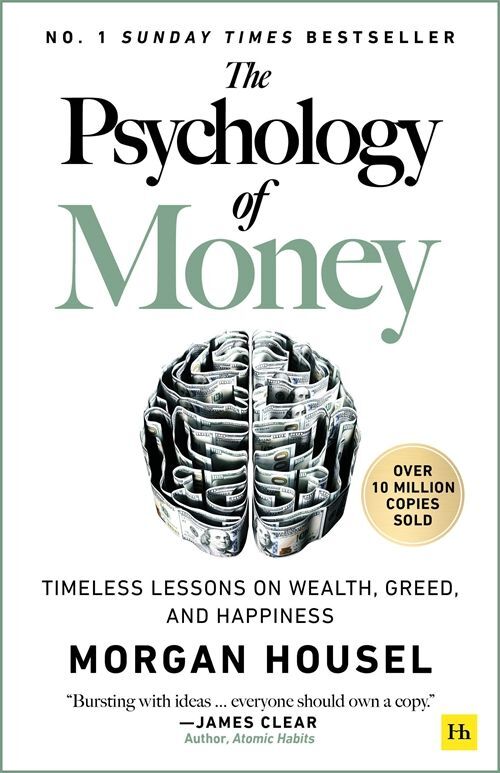
The Psychology of Money Review (2026): Morgan Housel on Wealth, Behavior, and the Real Reason People Mess Up Money
TL;DR: The Psychology of Money by Morgan Housel is one of the best personal finance books for people who are tired of spreadsheets-only advice. Instead of pretending money decisions are purely rational, Housel argues that wealth outcomes are heavily shaped by behavior, incentives, luck, fear, envy, time horizon, and the stories we tell ourselves. The result is a readable, idea-dense book that helps ordinary readers make saner financial choices, even if it will frustrate anyone looking for a technical investing manual or a step-by-step plan.
Want to check the book on Amazon?
See The Psychology of Money by Morgan Housel on Amazon
What The Psychology of Money is about
Morgan Housel’s central idea is simple, but it lands because it corrects a common mistake: doing well with money is not just a knowledge problem. It is a behavior problem. People rarely make financial choices from a clean, logical baseline. They make them while carrying childhood experiences, status anxieties, career uncertainty, political beliefs, family obligations, optimism, fear, and whatever just happened in markets this month. Housel uses a set of short, story-driven chapters to show how wealth, investing, saving, and spending are all shaped by psychology far more than most advice books admit.
That framing is the book’s biggest advantage. Instead of overloading the reader with formulas, Housel asks better questions: why do smart people make reckless money choices, why does compounding require patience that human emotions often sabotage, why do luck and risk matter more than hindsight lets us admit, and why is “enough” one of the most underrated financial concepts there is? It makes the book accessible without making it flimsy.
The structure also helps. Rather than building one giant thesis that depends on every chapter, the book offers a sequence of connected lessons. That makes it easy to read in small chunks, and it also suits the subject matter, because human financial behavior is messy and situational. Housel is not trying to give readers one perfect system. He is trying to improve their judgment.
Who it’s for
- Readers who want to become better with money without needing a finance degree first.
- Beginning and intermediate investors who have learned the mechanics of saving or index funds, but still feel emotional friction around money.
- People interested in wealth-building, long-term thinking, risk, and personal finance behavior.
- Anyone who likes nonfiction built from short stories, memorable examples, and clean prose rather than dense theory.
Who should skip it
- Readers looking for a tactical investing manual with portfolio allocations, security analysis, or detailed tax strategy.
- People who want a hard-edged “get rich fast” energy. This book is more reflective than aggressive.
- Advanced finance readers who already know the behavioral-finance basics and want something highly technical or novel.
Key ideas
The book’s most durable idea is that financial success is less about raw intelligence and more about consistent behavior over time. Housel keeps returning to the point that room for error matters, because plans that only work under perfect conditions usually fail in real life. This is why he emphasizes savings margins, modest expectations, and patience. A strategy that lets you stay in the game matters more than one that looks optimal on paper but collapses under stress.
Another key idea is the asymmetry of compounding. Wealth often grows in ways that look unimpressive for a long time and then suddenly look obvious in retrospect. That delay creates a psychological challenge: many people abandon sensible long-term behavior because the visible rewards arrive too slowly. Housel’s answer is not just “be disciplined.” It is to understand that the delay is part of the mechanism, not evidence that the strategy is broken.
He is also strong on the role of luck and risk. People love stories that turn outcomes into proof of virtue or incompetence, but Housel argues that real life is noisier than that. Some good decisions still lead to bad short-term outcomes, and some bad decisions get rewarded for a while. That matters because it makes readers less likely to overfit their beliefs to whatever just happened.
The “enough” chapter is arguably the moral core of the book. Housel argues that one of the greatest financial dangers is knowing no limit, especially when status comparison keeps moving the target. This lands because it connects money to behavior, identity, and happiness rather than treating finance as a detached optimization problem.
What the book gets right
The Psychology of Money gets the tone right first. Housel writes with clarity and restraint, which is rare in finance-adjacent nonfiction. He does not posture as a genius with secret access to the market. He sounds like someone trying to help readers avoid self-inflicted damage. That makes the book unusually easy to trust.
It also gets the scope right. Many personal finance books fail because they give technically correct advice that real humans cannot consistently follow. Housel’s focus on behavior solves that problem. He understands that anxiety, ego, social comparison, and impatience are not side issues. They are the main event. By treating them seriously, he produces advice that feels more durable than trend-driven money content.
The use of stories works well too. The examples make abstract ideas feel portable. You are more likely to remember a point about compounding, tail outcomes, or enoughness when it arrives through narrative rather than through jargon. That readability is part of the book’s value, not a simplification flaw.
What the book gets wrong, or at least undersells
The book occasionally risks being so universal that it becomes vague. Housel is excellent at shaping mindset, but he is less interested in translating that mindset into a specific execution plan. That is fine if you pair the book with more tactical resources. It is less fine if you expect the book alone to tell you exactly what to do next with debt, superannuation, retirement accounts, or asset allocation.
There is also a subtle survivorship bias risk in some of the storytelling. Housel openly discusses luck and risk, which helps, but anecdotal reasoning still has limits. Readers should treat the book as a lens for judgment, not as a substitute for understanding basic financial mechanics.
Some chapters may also feel familiar if you already consume a lot of behavioral finance or long-term investing content. The book’s strength is not that every insight is new. It is that the package is unusually coherent, readable, and emotionally accurate.
Practical takeaways
- Build a system you can stick with. Financial plans fail when they rely on perfect discipline during stressful periods.
- Respect room for error. Cash buffers, conservative assumptions, and margin are not inefficiencies. They are what keep good plans alive.
- Think in decades, not headlines. Compounding looks boring until it suddenly does not.
- Stop using other people’s goals as your benchmark. Lifestyle envy is expensive and endless.
- Define what “enough” means for you. Without that, more becomes an unstable target rather than a meaningful one.
- Judge decisions by process, not just immediate results. Short-term outcomes are noisy, especially in markets.
If you only take one lesson from the book, make it this: create a money strategy that is emotionally survivable. The best financial plan is usually not the theoretically highest-returning one. It is the one you can keep following when the world gets weird, your mood turns against you, or everyone around you is behaving irrationally.
Similar books
- Same as Ever by Morgan Housel, if you like the same clear style applied to risk, opportunity, and human behavior more broadly.
- The Simple Path to Wealth by J.L. Collins, if you want more direct investing guidance after finishing Housel’s mindset-first approach.
- I Will Teach You to Be Rich by Ramit Sethi, if you want more concrete systems for automating personal finance.
Sources
- Publisher page: Pan Macmillan, The Psychology of Money
- Amazon listing: Amazon product page for The Psychology of Money
- Reference overview: Wikipedia overview of The Psychology of Money
Final verdict
The Psychology of Money is worth reading because it improves the part of financial decision-making that most people actually struggle with: behavior under uncertainty. It does not replace detailed financial planning, and it is not pretending to. What it does is make readers calmer, more realistic, and more patient, which are deeply underrated advantages in money decisions. If you want a book that helps you think better about wealth, risk, savings, ambition, and contentment, this is an easy recommendation. If you want a pure how-to manual, use this as the mindset layer and pair it with something more tactical.
FTC disclosure: This post contains affiliate links. If you buy through them, Must Grab That may earn a commission at no extra cost to you.