The Dip Review (2026): Seth Godin on the Hard Part That Separates Winners From the Stuck
TL;DR: The Dip is Seth Godin’s short argument that persistence is overrated unless you are pushing through the right kind of difficulty. His big idea is simple: quit the dead ends fast, but stay stubborn when the pain is a temporary barrier that creates scarcity and rewards mastery. It is sharp, memorable, and useful for founders, creators, ambitious professionals, and anyone stuck between “push harder” and “walk away.” It is less useful if you want a deeply researched psychology book or a step-by-step operating manual.
Who it’s for
- Entrepreneurs deciding whether a project deserves another year of effort
- Creators, freelancers, and knowledge workers trying to separate a hard phase from a bad fit
- Managers who need a cleaner framework for focus, prioritization, and resource allocation
- Readers who like compact business books with one strong central argument
Who should skip it
- Readers who want dense case studies, academic evidence, or a long strategic playbook
- Anyone looking for a motivational “never quit” message, because this book argues almost the opposite
- People who already know they need execution systems more than mindset reframing
What the book is about
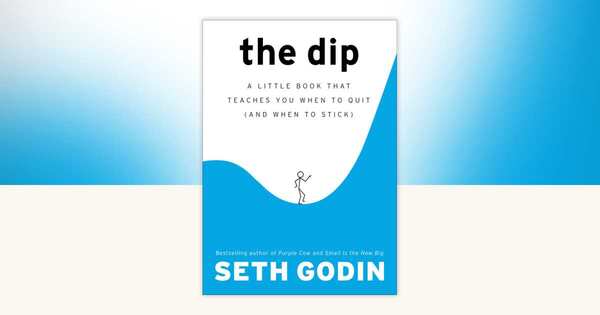
The Dip: A Little Book That Teaches You When to Quit (and When to Stick) is a very short book, but it punches above its size because Godin attacks a belief many people carry around without examining it: that grit is always good and quitting is a personal failure. His counterpoint is that nearly every worthwhile path has a painful middle. That middle, the dip, is exactly where most people leave. Because most people leave, the rewards on the other side stay available to the few who keep going.
But Godin does not stop at “push through.” He distinguishes between three situations. A Dip is a temporary stretch of difficulty that leads somewhere valuable. A Cul-de-Sac is a dead end that will not materially improve no matter how faithfully you keep grinding. A Cliff is a path where the costs keep escalating until failure becomes catastrophic. The practical challenge is not becoming more stubborn in general. It is getting better at diagnosis.
That is why the book still works. Most people do not fail only because they quit too early. They also fail because they stay trapped in the wrong thing for too long, partly out of ego and partly because sunk costs feel emotionally expensive. Godin’s framework gives language to a decision that otherwise stays muddy.
Key ideas
- Scarcity creates value. The reason top performers get outsized rewards is not that the work is glamorous. It is that the hard middle filters people out.
- Strategic quitting beats reactive quitting. Quitting because you planned clear limits is different from quitting because today feels bad.
- Average is crowded. In many markets, being pretty good at everything is less valuable than being exceptional at the thing that matters most.
- The right question is diagnostic. Ask whether the current pain is a temporary toll on the road to mastery, or evidence that the road itself is wrong.
- Decide in advance. Make quitting rules before emotions, fatigue, and public pride distort your judgment.
If you want to compare editions, formats, or pricing, these Amazon links are the simplest starting points: paperback search, Kindle search, and audiobook search.
What it gets right
The book is strongest when it reframes quitting as a skill instead of a shameful collapse. That matters because a lot of bad work, bad strategy, and bad careers persist on inertia. Teams keep funding weak initiatives. Founders keep polishing products with no real traction. Professionals stay in roles that are not teaching them anything because leaving would feel like failure. Godin gives permission to stop pretending perseverance is automatically noble.
It also gets the economics right in a way many motivational books miss. The pain of mastery is not an unfortunate side effect. It is often the mechanism that creates the opportunity. If becoming excellent were easy, excellence would not command attention or money. That is a useful lens for business, writing, sales, fitness, and almost any competitive craft.
Another strength is the book’s portability. You can apply it to a side hustle, a client niche, a job search, a startup, a training plan, or even a content strategy. It helps cut through noise and forces a more honest question: am I in a hard season that compounds, or am I stuck in a loop that only feels productive because it is familiar?
What it gets wrong, or at least leaves thin
The downside of the book’s speed is that it can feel more like a sharp manifesto than a full decision system. The central distinction is memorable, but the hard part is still judgment. In real life, dips and dead ends can look identical for longer than anyone likes. The book does not provide enough operational detail for evaluating uncertainty, time horizons, opportunity cost, or personal constraints.
It also leans hard into the rewards of being the best without spending much time on the risks of winner-take-most thinking. Not everyone needs to be number one. In many careers and businesses, “reliably very good” can still be financially and personally excellent. Godin intentionally writes in bold strokes, which is part of the appeal, but it means readers should bring some nuance with them.
Finally, some readers will want more evidence. The argument is intuitive and often persuasive, yet this is not a research-heavy book. It is closer to a strategic provocation than a fully sourced behavioral science text.
Practical takeaways
- Set quitting criteria before starting. Define the metrics or conditions that would make you stop, pivot, or double down.
- Audit your current projects. Label each one as likely Dip, Cul-de-Sac, or Cliff. If you cannot label it, you probably need better data.
- Protect resources for the few things that matter. Spreading effort across too many average bets keeps you trapped in mediocrity.
- Do not confuse discomfort with doom. Some resistance is the toll booth for meaningful progress.
- Do not confuse busyness with progress. A dead end can still keep you very busy.
My verdict
This is one of those small books that earns its shelf space because it gives you language for a recurring adult problem. I would not treat it as a complete operating system. I would treat it as a mental sorting tool, and a very good one. If you are overcommitted, half-stuck, or unsure whether persistence is courageous or just expensive, The Dip is worth reading.
My practical rating is 4.3/5. It is not deep enough to be definitive, but it is clear enough to change decisions. That is often more valuable.
Similar books
- Deep Work by Cal Newport, for readers who want a stronger argument for concentrated effort
- Essentialism by Greg McKeown, for readers who need better criteria for what not to do
- The War of Art by Steven Pressfield, for readers fighting resistance in creative work
- Thinking in Bets by Annie Duke, for readers who want better judgment under uncertainty
Sources
- Penguin Random House book page for The Dip: publisher listing
- CBS excerpt from The Dip: excerpt and interview context
- Amazon search results for discovery and formats: Amazon search
FTC disclosure: This post contains affiliate links. If you buy through them, Must Grab That may earn a commission at no extra cost to you.