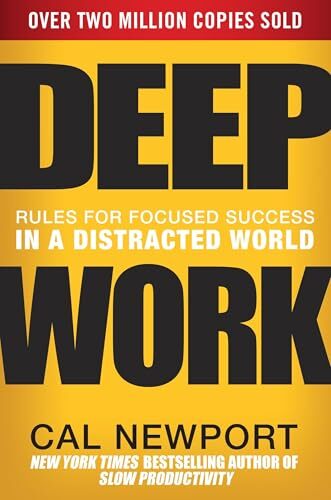
Deep Work Review (2026): Cal Newport on Focus as a Career Advantage
TL;DR: Deep Work argues that sustained, distraction-free concentration is becoming more valuable precisely as it becomes rarer. Cal Newport mixes a cultural argument with a training manual: protect focus, reduce shallow work, and build rituals that make meaningful output more likely. It is still one of the better productivity books for knowledge workers who feel busy all day but underwhelmed by what they actually finish.
Want to check the book on Amazon?
See Deep Work by Cal Newport on Amazon
What Deep Work is about
Cal Newport’s central claim is simple and sticky: the ability to focus intensely on demanding work is a competitive advantage, and modern professional life is systematically designed to erode that advantage. Instead of accepting permanent fragmentation as the price of being connected, Newport argues that concentration should be treated like a career asset. The book defines “deep work” as professional activity performed in a state of distraction-free concentration that pushes your cognitive capabilities to their limit. That kind of effort, he says, creates more value, improves skill faster, and is more satisfying than the familiar churn of inboxes, meetings, pings, and low-stakes administrative tasks.
The structure works well. The first half makes the case for why depth matters. The second half tries to operationalize it with rules and examples. Newport is strongest when he shows that focus is not just a personality trait but an environment-and-habits problem. If your default day is reactive, your best thinking will keep getting pushed into smaller, more exhausted corners of your schedule.
Who it’s for
- Knowledge workers who spend most of the day at a computer and feel constantly interrupted.
- Managers, founders, freelancers, writers, developers, analysts, researchers, and students doing cognitively demanding work.
- People who already suspect their phone, inbox, and open-ended collaboration habits are costing them more than they admit.
- Readers who want practical rules, not just a motivational speech about “focus.”
Who should skip it
- People looking for a soft, forgiving book about balance. Newport is more disciplined than comforting.
- Readers whose jobs are heavily customer-facing or genuinely interruption-driven, where long blocks of solitude are difficult to engineer.
- Anyone wanting novel neuroscience or groundbreaking new research. The value here is in framing and application, not scientific novelty.
Key ideas
The biggest idea is the “deep work hypothesis”: deep work is becoming increasingly valuable at the same time it is becoming increasingly rare. That combination means the people who deliberately cultivate it can separate themselves. Newport is not merely saying distraction is annoying. He is saying distraction is economically and creatively expensive.
He then builds around four memorable rules: work deeply, embrace boredom, quit social media, and drain the shallows. The advice underneath those labels is more useful than the slogans suggest. “Work deeply” becomes a question of rituals, scheduling, place, duration, and rules. “Embrace boredom” pushes back against the reflex to fill every idle second with stimulation. “Quit social media” is less an absolutist command than an invitation to evaluate tools by net benefit rather than vague social pressure. “Drain the shallows” asks you to notice how much time goes to low-value logistical maintenance and to cap it more aggressively.
One thing Newport gets right is that attention is trainable. If you repeatedly fragment it, you get better at fragmentation. If you repeatedly protect it, you get better at depth. That is intuitive, but it lands because he ties it to concrete behavior rather than abstract willpower.
What the book gets right
Deep Work succeeds because it names a problem many people feel before they can articulate it. Plenty of professionals are not lazy, unmotivated, or untalented, they are simply trapped in systems that reward visible responsiveness over meaningful output. Newport gives that frustration a vocabulary and a counter-model.
The book is also unusually practical for a popular productivity title. Newport does not pretend one perfect routine works for everyone. He offers multiple philosophies of scheduling deep work, from monastic isolation to more realistic rhythmic habits. That flexibility makes the book usable. It is also refreshingly skeptical of digital defaults. Newport treats constant connectivity not as an unquestioned good but as a tradeoff, and that skepticism has aged well.
Another strength is that he links focus to fulfillment, not just performance. The argument that deep effort can make work more satisfying is important. Many readers come for productivity and stay for the deeper point: attention shapes experience. A distracted life can feel thin even when it looks full from the outside.
What the book gets wrong, or at least oversimplifies
At times, Newport underestimates how politically and structurally constrained many jobs are. It is one thing to advise boundaries around email and meetings; it is another to do that when you are junior, under-resourced, or working inside a culture that interprets delayed replies as poor performance. Some of the book’s confidence comes from examples drawn from people with more autonomy than the average reader.
The book can also sound harsher than necessary about networked work. Not all collaboration is shallow, and not every visible communication task is a useless tax. For many roles, relationship maintenance, quick clarifications, and accessible responsiveness are part of the real value they create. Newport is best read as a corrective, not a total operating system.
Finally, if you already read widely in productivity, digital minimalism, or attention science, some examples may feel familiar. The originality is less in any single tactic than in how forcefully the book assembles them into a coherent worldview.
Practical takeaways
- Schedule focus before the day fills up. If deep work matters, it cannot rely on leftover time.
- Create a ritual. Decide where you work, for how long, what you will work on, and what is off-limits during that block.
- Stop rewarding your own distraction. If every spare minute goes to your phone, boredom tolerance never returns.
- Measure output, not just activity. A full day of replies can still be a low-result day.
- Reduce shallow work intentionally. Ask which meetings, messages, and recurring tasks actually move outcomes.
- Use technology selectively. Tools should earn their place by materially supporting what you value.
If you only apply one lesson from the book, make it this: block a recurring, protected session for meaningful work and defend it like a real appointment. That single change often reveals how much mental energy has been leaking into reactive noise.
Similar books
- Digital Minimalism by Cal Newport, if you want a more direct critique of modern digital habits.
- Atomic Habits by James Clear, if you want behavior-change mechanics that pair well with Newport’s philosophy.
- The ONE Thing by Gary Keller and Jay Papasan, if you like productivity advice built around prioritization and constraint.
Sources
- Publisher page: Hachette Book Group, Deep Work
- Author page: Cal Newport on Deep Work
- Amazon listing: Deep Work on Amazon
Final verdict
Deep Work remains useful because the underlying problem has only intensified. The tools changed, the notification load increased, and AI added another layer of synthetic busyness, but Newport’s core warning still holds: if you cannot concentrate for long enough to do something difficult, you will struggle to produce rare, high-leverage work. Not every reader can apply his advice cleanly, and some workplaces make depth genuinely hard to defend. Still, as a diagnosis plus a practical push toward better habits, the book is durable. If you feel chronically busy but oddly unaccomplished, this is still one of the first books I’d point you to.
FTC disclosure: This post contains affiliate links. If you buy through them, Must Grab That may earn a commission at no extra cost to you.