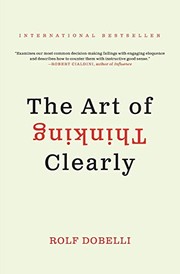
The Art of Thinking Clearly Review (2026): Rolf Dobelli’s Fast Guide to Smarter Decisions
The Art of Thinking Clearly by Rolf Dobelli is a fast, idea-dense tour through the cognitive biases that quietly wreck judgment. Instead of pretending humans are rational and then acting surprised when they are not, Dobelli gives readers a checklist of predictable mental errors, from confirmation bias and sunk-cost fallacy to survivorship bias, social proof, and overconfidence. The result is not a grand unified theory of life. It is something more useful for everyday decisions: a practical reminder that smart people still get fooled, especially when they are rushed, emotional, or trying to protect their ego.
TL;DR
This is a strong starter book on bad thinking habits, especially for readers who like short chapters and concrete examples. Dobelli is good at naming the traps people fall into, and once those traps have names, they become much harder to miss in meetings, investing decisions, media consumption, productivity plans, and personal life. The tradeoff is depth. Because the book moves through 99 biases quickly, some chapters feel more like sharp reminders than fully developed arguments. I would recommend it as a pattern-recognition book, not as the last word on behavioral science.
Who it’s for, and who should skip it
Read it if: you enjoy books that can be picked up in short bursts, you make decisions under uncertainty, you manage people, you invest, negotiate, or buy things online, or you want a compact introduction to cognitive bias without wading through a more academic text. It is especially useful for founders, managers, marketers, writers, and anyone who keeps noticing that “obvious” decisions somehow become messy in real life.
Skip it if: you want a tightly argued research book with long evidence sections, or if you already know the standard catalog of biases from Daniel Kahneman, Annie Duke, Shane Parrish, or similar authors. In that case, Dobelli may feel like a clever refresher rather than a revelation. Also skip it if you dislike books built from many short chapters, because this one is intentionally fragmented.
Key ideas
The big idea is simple: human judgment is not just imperfect, it is predictably imperfect. We do not merely make random mistakes. We make repeatable mistakes, in repeatable patterns, for repeatable reasons. Dobelli walks through those reasons in bite-size chapters so readers can spot them while they are happening.
- Confirmation bias: once we form a belief, we start collecting evidence that flatters it and filtering out evidence that threatens it.
- Sunk-cost fallacy: people keep pouring time, money, or attention into bad choices because quitting feels like admitting the earlier investment was wasted.
- Survivorship bias: we learn from visible winners while ignoring the much larger graveyard of failures that used the same strategy.
- Social proof and authority bias: people borrow confidence from the crowd or from status figures instead of checking whether the underlying claim is actually good.
- Overconfidence: the less uncertainty we feel, the more dangerous we can become, because certainty is often a feeling, not a fact.
One reason the book works is that it keeps dragging abstract psychology back into ordinary life. Dobelli is not talking only about laboratory effects. He is talking about buying stocks because other people look rich doing it, keeping side projects alive long after they stop making sense, mistaking media visibility for truth, and rationalizing decisions after the fact. That practical angle is why the book has stayed popular.
What it gets right
The best thing about this book is usability. Dobelli strips complicated ideas down to memorable labels and examples, which makes the lessons portable. You can read a chapter in two minutes and then catch yourself committing that exact error the same afternoon. That is real value. A lot of “smart thinking” books are more impressive than useful. This one leans the other way.
It also gets the tone mostly right. Dobelli does not present bias as a moral failure. He presents it as a default setting of human cognition. That matters, because shame is not a reliable correction tool. Awareness and systems are. The book quietly nudges readers toward better decision hygiene: delay impulsive judgments, ask what evidence would disconfirm your belief, separate outcomes from process, and beware stories that sound too neat.
I also like that the book punctures lazy optimism. It reminds readers that intelligence does not immunize anyone against self-deception. In practice, smart people often become better at defending bad conclusions. That is an uncomfortable point, but it is true enough to be useful.
What it gets wrong, or at least understates
The weakness is compression. Covering 99 biases in a relatively short book means many chapters are memorable but thin. You get the name of the trap and a good anecdote, but not always enough nuance about when the effect is strongest, how researchers define it, or what countermeasures work best. Readers who want methodological detail will need to go elsewhere.
The book can also feel like a parade of human irrationality without a matching framework for building better environments. Naming biases helps, but individuals do not outthink every bias through willpower alone. Better checklists, clearer incentives, slower decision cycles, outside feedback, and written reasoning often matter more than raw awareness. Dobelli points in that direction, but the book is stronger at diagnosis than treatment.
There is also some overlap between chapters, which is probably unavoidable in a catalog format. Certain ideas blur together. That does not ruin the book, but it does make it better for gradual reading than for cover-to-cover bingeing.
Practical takeaways
- Write the decision before the result happens. This helps separate a sound process from a lucky outcome.
- Ask what would change your mind. If the answer is “nothing,” you are probably protecting identity, not pursuing truth.
- Treat time and money already spent as gone. The only question that matters is whether the next unit of effort is worth it now.
- Study base rates before success stories. Case studies are seductive, but odds matter more than anecdotes.
- Reduce exposure to noisy inputs. Constant news, hot takes, and social validation loops make several biases worse at once.
For most readers, that is the real payoff. The book makes you just skeptical enough of your first interpretation, which is often the difference between a decent decision and a dumb expensive one.
Similar books
If this book clicks for you, these Amazon searches are the next logical step:
- Browse Rolf Dobelli books on Amazon
- Search for Thinking, Fast and Slow on Amazon
- Search for Decisive on Amazon
- Search for Thinking in Bets on Amazon
Verdict
The Art of Thinking Clearly is worth reading if you want a practical mental-error field guide rather than a dense academic textbook. Its best use is not to turn you into a flawless thinker, because that is not happening. Its best use is to make you pause long enough to notice when your brain is trying to sell you a flattering but weak story. That alone can save money, time, and avoidable regret.
My take: it is a valuable gateway book and a very giftable one. I would not rank it above the deepest books in the decision-making category, but I would absolutely rank it among the most accessible. For the right reader, accessibility is not a compromise. It is the whole point.
Sources
- Amazon book listing for The Art of Thinking Clearly
- Wikipedia overview of The Art of Thinking Clearly
- Goodreads listing and reader metadata
FTC disclosure: This post contains affiliate links. If you buy through them, Must Grab That may earn a commission at no extra cost to you.