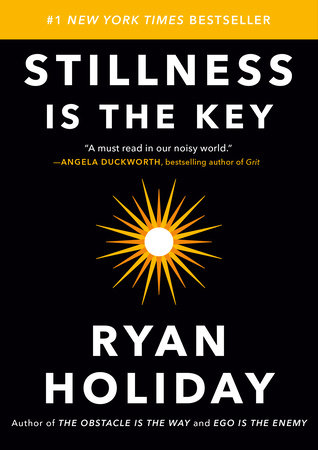
Stillness Is the Key Review (2026): Ryan Holiday on Calm as a Competitive Advantage
Ryan Holiday’s Stillness Is the Key is one of those books that sounds soft until you realize it is really about control, attention, and emotional discipline. Holiday argues that the highest performers are not the people with the most intensity, noise, or constant motion. They are the people who can stay clear-headed while everyone else gets spun up. That is the promise here, and for the most part, he delivers.
Quick verdict: this is a strong, readable modern entry point into Stoic and contemplative ideas. It is especially useful if your brain feels crowded, your days are reactive, or your ambitions are outrunning your ability to think calmly. It is less useful if you want a rigorous philosophy text, original academic argument, or a system with lots of experiments and worksheets.
Amazon pick: Want to check editions, Kindle pricing, or audiobook options for Stillness Is the Key?
TL;DR
Stillness Is the Key turns Stoic, Buddhist, and reflective traditions into a practical message for modern life: you think better, act better, and suffer less when you create space between stimulus and response. Ryan Holiday packages that idea in a highly readable way, with short chapters, historical stories, and memorable lines. The upside is accessibility. The downside is that some sections can feel repetitive, simplified, or a little too polished for readers who want deeper philosophical meat. Still, if you want a book that nudges you toward less reactivity and more inner order, this is a very solid buy.
Who it’s for / Who should skip
Best for:
- Ambitious readers who feel mentally overclocked
- People interested in Stoicism but not ready to start with ancient primary texts
- Founders, managers, creators, and knowledge workers drowning in distraction
- Readers who like books that blend history, philosophy, and self-improvement
Skip if:
- You want a scholarly treatment of Stoicism, Buddhism, or meditation traditions
- You dislike anecdote-heavy nonfiction
- You already know Holiday’s style and want something more technical or novel
- You need a tightly structured habit program rather than reflective guidance
Key ideas
The core claim is simple: stillness is not laziness, retreat, or passivity. It is the internal steadiness that lets you see clearly, resist impulse, and choose deliberately. Holiday breaks this into three broad arenas, mind, spirit, and body. In practice, that means mental clarity, emotional balance, and physical self-command.
He leans on examples from politics, sports, military history, religion, and literature to show that the calmest person in the room often has the biggest long-term advantage. A leader who can pause avoids stupid escalation. A creator who protects attention does better work. A person who is not owned by ego can hear reality faster.
Holiday also keeps returning to a point that lands well in 2026: our attention environment is hostile to wisdom. Constant inputs, outrage cycles, and performative busyness make stillness feel unproductive, when it is often the exact condition needed for good judgment.
What it gets right
1. It makes old wisdom usable. This is Holiday’s real strength. He does not write like a professor. He writes like someone translating durable ideas into modern operating instructions. If you have bounced off denser philosophy before, this book is a much easier on-ramp.
2. It respects the cost of distraction. Plenty of self-help books talk about focus in a vague way. Holiday ties inner agitation to real consequences, bad decisions, ego traps, emotional overreaction, and shallow work. That makes the argument feel practical rather than mystical.
3. The stories are sticky. Whether he is talking about Marcus Aurelius, Churchill, Fred Rogers, or athletes shaped by disciplined practice, the examples make the lessons memorable. You may not remember every section heading, but you will remember the broader pattern: calm is leverage.
4. It is readable without being flimsy. The prose is clean, the chapters move quickly, and the message is consistent. For a broad audience, that matters more than philosophical perfection.
What it gets wrong, or at least oversimplifies
1. It can flatten complex traditions. Holiday draws from Stoicism, Buddhism, and historical biography, but this is synthesis, not deep scholarship. If you are well-read in those areas, some passages will feel compressed or selectively interpreted.
2. The formula becomes familiar. If you have read The Obstacle Is the Way or Ego Is the Enemy, you will recognize the rhythm: polished anecdote, distilled lesson, practical moral. It works, but it can also feel brand-consistent in a way that reduces surprise.
3. Not every reader will love the example stack. Historical and celebrity examples are effective, but they can also create a borrowed-authority effect. Sometimes you want less inspiration theater and more direct method.
4. Stillness can sound easier than it is. The book is best read as a compass, not a full treatment plan. If your attention is shredded by stress, anxiety, burnout, or a brutal schedule, the concept helps, but you may need stronger systems and professional support to make it real.
Practical takeaways
- Build pauses on purpose. Before replying, buying, posting, or escalating, create a small delay. Stillness often starts as a tiny gap.
- Reduce input to improve output. Fewer notifications, fewer tabs, less compulsive checking. Holiday’s argument only works if you defend your attention.
- Journal to hear yourself think. Several examples in the book point toward writing as a clarifying tool, not a performative one.
- Protect solitude without turning it into a personality brand. The point is not to look serene. The point is to become less ruled by noise.
- Use the body to calm the mind. Sleep, walking, breathing, training, and time away from screens are not side quests. They are part of the same discipline.
That is why this book works best for readers who are not asking, “How do I optimize one habit?” but rather, “How do I stop living in a permanent state of inner friction?”
Similar books
- The Obstacle Is the Way by Ryan Holiday, if you want a more action-oriented Stoic frame
- Ego Is the Enemy by Ryan Holiday, if your main challenge is self-importance rather than distraction
- Wherever You Go, There You Are by Jon Kabat-Zinn, if you want a more explicitly mindfulness-centered path
Sources
- Publisher description and author page: Penguin Random House, Stillness Is the Key by Ryan Holiday
- Amazon listing for edition and format discovery
- General public review discourse used for balance, including reader and critic commentary surfaced in search results
Final verdict
Stillness Is the Key is not the last word on philosophy, meditation, or self-mastery, but it is a useful one. Ryan Holiday is very good at taking an old principle and making it feel urgent for people trapped in modern noise. This book’s best idea is not that stillness is nice. It is that stillness is strategically powerful. When you stop being jerked around by ego, urgency, and distraction, you become harder to manipulate and better able to do meaningful work.
That said, I would not oversell it as a complete method. Think of it as a clean, persuasive reset. It can help you notice the cost of inner chaos and point you toward a calmer operating style. If that is the problem you are trying to solve, this is a worthwhile read.
FTC disclosure: This post contains affiliate links. If you buy through them, Must Grab That may earn a commission at no extra cost to you.