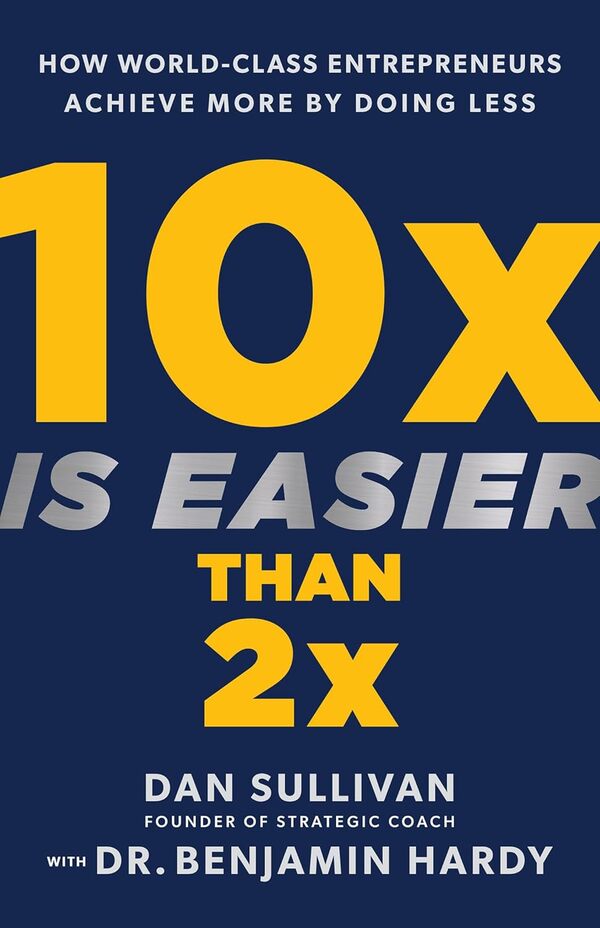
10x Is Easier Than 2x Review (2026): Bigger Goals, Less Busywork?
10x Is Easier Than 2x by Dan Sullivan and Dr. Benjamin Hardy makes a bold promise: stop chasing incremental improvement and start designing a business and life around bigger, cleaner leaps. The core idea is that 2x growth usually tempts you to keep doing more of the same, while 10x growth forces you to eliminate, simplify, delegate, and focus only on the work that actually matters.
TL;DR
This is a useful mindset book for entrepreneurs, operators, and ambitious professionals who are stuck in the trap of doing more without getting proportionally better results. Its best point is simple and sticky: bigger goals can force better decisions. Instead of piling more tasks onto an already messy calendar, the book argues that true growth comes from subtracting low-value work, protecting your unique strengths, and building around freedom, not busyness. It is energizing, memorable, and easy to discuss with a team. It is less convincing if you want rigorous case-study depth, step-by-step operating systems, or advice tailored to ordinary salaried jobs with low control. Overall, it is a strong strategic reframing tool, not a full execution manual.
Who it’s for
- Founders, small business owners, consultants, and executives who feel trapped by complexity.
- Readers who like business books built around a few big mental models rather than dense spreadsheets and tactics.
- People already familiar with Dan Sullivan, Strategic Coach, or Benjamin Hardy’s earlier books like Who Not How on Amazon.
Who should skip it
- Readers who want detailed evidence, research citations, or industry-by-industry playbooks.
- Anyone who is allergic to entrepreneurial self-help framing and premium-coaching language.
- People looking for a beginner productivity system with checklists, templates, and daily habits spelled out in full.
Key ideas
1. 2x growth usually preserves your current identity. One of the book’s most useful distinctions is that modest growth often leaves your current habits intact. You keep the same meetings, the same customers, the same mediocre opportunities, and just try to squeeze out more volume. That feels safer, but it also keeps you chained to the old version of your business.
2. 10x growth forces subtraction. The counterintuitive claim is that a truly bigger goal makes you drop the bottom 80 percent of activities that do not deserve your attention. Even if the exact percentages are rhetorical, the practical point lands. You cannot get radically better by carrying every obligation forward.
3. Freedom matters more than raw output. The book keeps returning to four freedoms, time, money, relationship, and purpose. That is an appealing framework because it shifts the conversation away from vanity metrics and toward the actual shape of your life. More revenue means less if your calendar is destroyed and every success creates fresh chaos.
4. Unique ability should drive your role. Sullivan’s long-running theme is that you should spend more time in the work only you can do especially well. The book treats delegation not as a nice productivity trick but as the gateway to compounding. If someone else can do a task competently, there is a good chance it should stop living on your plate.
5. Identity drives strategy. Hardy’s influence shows up in the emphasis on future-self thinking. The argument is that the person capable of 10x results is not merely your current self with a bigger to-do list. It is a more selective, more decisive version of you.
What the book gets right
The best thing about 10x Is Easier Than 2x is that it exposes the hidden cost of incrementalism. A lot of professionals say they want growth, but what they really want is familiar work with slightly better outcomes. This book challenges that compromise directly. Bigger targets can indeed make lower-value opportunities easier to reject, and that is often more important than any productivity hack.
It also gets the emotional side of ambition right. Many business books talk as if scaling is a math problem. Sullivan and Hardy understand that it is also an identity problem. People cling to tasks that make them feel useful, even when those tasks block expansion. The book is strong whenever it pushes the reader to stop confusing control with contribution.
Another strength is readability. The ideas are repetitive in a deliberate way, which makes the framework easy to remember and easy to explain to a co-founder or leadership team. If you want a book that can trigger a clean strategic conversation in one weekend, this is the kind of title that does that well.
What the book gets wrong, or at least oversimplifies
The biggest weakness is that the book can feel more like a persuasive manifesto than a balanced analysis. The central claim is memorable, but the evidence base is mostly anecdotal and principle-driven. Readers who want more hard examples, failed cases, or nuanced discussion of when 10x thinking backfires may finish wanting more.
It also assumes a level of autonomy that many readers do not fully have. Founders can redesign roles, replace clients, and reshape strategy faster than mid-level employees can. The core mental model still helps in a normal job, but the application is clearly optimized for entrepreneurs with room to restructure.
Finally, some readers will feel that the book underweights operational reality. Delegation, focus, and simplification are powerful, but they do not remove the need for systems, hiring judgment, cash discipline, and timing. In practice, 10x thinking works best when paired with sober execution habits, not as a substitute for them.
Practical takeaways
- Audit your calendar by energy, not just time. Mark the activities that create disproportionate results and the ones that merely preserve motion.
- List the clients, products, or commitments you would not choose again today. That is usually where your 2x trap is hiding.
- Define your unique ability zone. Be specific about the work that combines talent, energy, and strategic value.
- Use a bigger target as a filter. Ask which projects still matter if you are aiming for a radically better business, not a slightly busier one.
- Build support before ambition collapses under logistics. If the idea resonates, the next step is not more hustle. It is better delegation, clearer priorities, and fewer open loops.
Similar books
If this book clicks for you, the closest companions are the authors’ own adjacent titles. The Gap and The Gain on Amazon explores the measurement mindset behind satisfaction and progress, while Who Not How on Amazon is the cleaner delegation-focused companion. For readers who want a more classic focus-and-elimination angle, books like Essentialism or Deep Work can also pair nicely, though they come from a less entrepreneurial lane.
Sources
- Official book site: 10xeasierbook.com
- Publisher page: Penguin Random House listing
- Author books page: BenjaminHardy.com books page
- Retail reference and cover source: Amazon Australia product page
Bottom line: 10x Is Easier Than 2x is worth reading if you need a sharp mental reset around growth, selectivity, and freedom. It is not the last word on scaling, but it is very good at making mediocre expansion look as costly as it often is.
FTC disclosure: As an Amazon Associate, Must Grab That may earn from qualifying purchases made through affiliate links in this post.