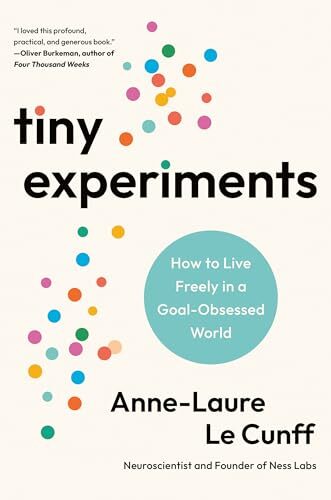

TL;DR: Tiny Experiments by Anne-Laure Le Cunff is a thoughtful antidote to the rigid, optimize-everything self-help style that dominates productivity shelves. Instead of telling you to lock in a five-year plan and grind harder, Le Cunff argues for running small, low-risk experiments in your work and life so you can learn what actually fits you. It is strongest when it helps overthinkers escape perfectionism and identity traps; it is weaker if you want a high-pressure, step-by-step execution system with hard metrics and aggressive accountability. For curious readers, creators, career-switchers, and anyone stuck between too many options, this is a genuinely useful read.
Anne-Laure Le Cunff’s core idea is simple: most people are trying to solve uncertainty with bigger goals, tighter plans, and more pressure, when a better response is often to lower the stakes and increase the learning. Instead of treating every decision like a referendum on your identity, she suggests treating it like an experiment. That means making smaller bets, paying attention to evidence from your real life, and being willing to update your path instead of defending an outdated plan just because you announced it loudly. That framing sounds modest, but it has big consequences for how you approach career choices, creative projects, habits, learning, and even personal reinvention.
Who it’s for
- People who feel trapped by traditional goal-setting and productivity culture.
- Career changers, side-project builders, founders, and creators who are navigating uncertainty.
- Overthinkers who wait too long for the “right” decision and need a lower-risk way to move.
- Readers who like reflective, behavior-change nonfiction rather than hustle content.
Who should skip it
- Readers who want a ruthless execution manual with strict checklists and KPI-style accountability.
- Anyone looking for a deeply technical neuroscience text; the book is accessible, not academic in tone.
- People who already thrive with clear, fixed goals and do not struggle with identity pressure or perfectionism.
Key ideas
The book’s most compelling contribution is the shift from an “achievement mindset” to an “experimental mindset.” In a goal-obsessed culture, we are taught to define success early, optimize relentlessly, and interpret deviations as failure. Le Cunff pushes back on that logic. She argues that fixed goals can become cages, especially when they are set before you have enough information about yourself, your environment, or what the work actually feels like day to day. Tiny experiments, by contrast, let you test assumptions before making expensive commitments.
That sounds obvious, but it is surprisingly rare advice in self-help publishing. Most books reward certainty. This one rewards curiosity. Instead of saying “pick a lane and double down,” it asks, “What is the smallest real-world test you can run to gather signal?” That could mean trying a new workout style for two weeks before buying an expensive setup, publishing a small creative project before rebranding your whole career, or testing a new routine with a narrow scope instead of attempting a total life overhaul on Monday morning.
Another strong idea in the book is the separation between identity and outcome. A lot of people stay stuck because they make every experiment mean too much. If the project succeeds, it proves they are talented; if it fails, it proves they are not. Le Cunff’s approach reduces that psychological load. An experiment is not a verdict. It is a way to learn. That makes it easier to start, easier to notice what is working, and easier to quit things that looked good in theory but do not survive contact with reality.
She also writes persuasively about uncertainty as something to navigate rather than eliminate. That is one of the book’s quiet strengths. Instead of promising total clarity, it offers a more realistic model: clarity often arrives after action, not before it. For readers who have spent years trying to think their way out of ambiguity, that is a useful and liberating correction.
What the book gets right
First, it respects the messy way real lives work. A lot of advice books assume you can isolate one variable, commit fully, and execute inside a stable environment. In reality, people are juggling jobs, families, energy constraints, changing priorities, and imperfect information. The tiny-experiments framework fits actual life because it is adaptable. You do not need certainty, perfect timing, or a dramatic leap. You need a testable next step.
Second, the tone is refreshingly humane. Le Cunff does not write like a motivational drill sergeant. The voice is thoughtful, smart, and grounded in observation rather than chest-thumping. That makes the book easier to trust, especially if you are tired of high-volume advice built on intensity rather than insight.
Third, the framework is practical. This is not just a philosophical defense of curiosity. The real value is that readers can take the core concept and apply it immediately: define a hypothesis, keep the scope small, decide what you want to learn, run the test, and review the evidence. That pattern works across work, health, learning, business, and creativity.
What it gets wrong or where it’s weaker
The same gentleness that makes the book appealing can also make it feel underpowered for some readers. If you are in a situation that demands speed, hard constraints, or decisive execution, the experimental approach may feel too soft. There are moments when you do need commitment rather than prolonged exploration, and readers already prone to endless tinkering could use this framework as a socially acceptable way to delay bigger decisions.
There is also a natural limitation to any mindset-first book: the quality of the outcome depends on the reader’s honesty. Running experiments sounds smart, but poorly designed experiments can become avoidance in disguise. If you never define success criteria, never set a time box, or never review what the evidence says, you are not experimenting — you are drifting. The book points readers in the right direction, but some people will still need more structure than it provides.
Finally, readers expecting a heavily research-cited, academically dense treatment may find the book more conversational than scholarly. That is not a flaw for most people, but it is worth noting. The book is built to be used, not admired from a distance.
Practical takeaways
- Replace identity-heavy goals with lightweight tests. Instead of saying, “I am going to become a runner,” try “I will test three 20-minute runs over the next ten days and see how my energy and recovery feel.”
- Time-box uncertainty. Give experiments a clear window so they do not stretch forever.
- Decide what signal matters before you start. Enjoyment, energy, traction, revenue, consistency, stress — pick the measure that fits the decision.
- Stop treating quitting as failure. Ending a bad-fit experiment early can be evidence of good judgment.
- Use small bets to escape perfectionism. A rough, real-world test usually teaches more than another week of planning.
For mustgrabthat readers, the big appeal is that this book lines up with how smart buying decisions work too: you do not need to overhaul your life overnight. You run smaller tests, look for what actually helps, and then scale the things that earn their place. That is a much better model than buying a perfect identity in one click.
Similar books
- Search Atomic Habits on Amazon — better for habit mechanics and behavior design.
- Search Designing Your Life on Amazon — stronger on life design and prototyping career choices.
- Search Deep Work on Amazon — better if your main problem is distraction and focus.
- Search Tiny Experiments on Amazon — useful if you want to compare formats and editions.
Bottom line
Tiny Experiments is not the loudest self-help book on the shelf, and that is exactly why it works. It offers a calmer, smarter response to the pressure to optimize your entire life in public. Its core message — lower the stakes, run the test, learn from reality, update honestly — is practical enough to use and humane enough to stick. If you are stuck, restless, or trying to make a change without turning your life into a performance, this is a worthwhile read.
Sources
- Author book page: Tiny Experiments by Anne-Laure Le Cunff
- Amazon listing for Tiny Experiments
- Amazon Kindle edition listing
FTC disclosure: This post contains affiliate links. If you buy through them, Must Grab That may earn a commission at no extra cost to you.