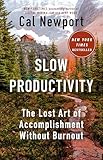

TL;DR: Slow Productivity: The Lost Art of Accomplishment Without Burnout is Cal Newport’s argument that knowledge workers get worse results when they confuse visible busyness with meaningful output. His answer is not laziness, and it is not hustle with better branding. It is a deliberately slower operating system built on doing fewer things, working at a natural pace, and obsessing over quality. I think it is one of the more useful productivity books for people who already know the obvious advice and are tired of living inside inboxes, Slack pings, and self-inflicted urgency loops.
Newport’s core claim is simple: modern knowledge work drifted into a mode where responsiveness became more visible than craft. That drift rewards fast replies, packed calendars, and shallow motion, even when none of those things produce work anyone will care about in a year. Slow Productivity pushes back by borrowing from slower, more durable forms of accomplishment. Newport looks at writers, academics, craftspeople, and other people who produced meaningful bodies of work without making permanent overload their identity.
Who it’s for
- Knowledge workers whose days vanish into email, chat, meetings, and task-switching.
- Managers, founders, freelancers, and creatives who want output that compounds instead of constant reactive churn.
- Readers who liked Deep Work on Amazon but want a broader system for sustainable execution.
- People who feel productive all day and still struggle to point to anything substantial finished at week’s end.
Who should skip
- Anyone looking for a high-energy motivational kick rather than a change in operating philosophy.
- Workers in highly constrained service roles where schedule control is minimal and responsiveness is non-negotiable.
- Readers who want detailed corporate politics tactics for fixing a broken workplace from the bottom up.
What the book is about
Newport builds the book around three principles: do fewer things, work at a natural pace, and obsess over quality. Those sound almost too clean on the page, but the value is in how he explains them. “Do fewer things” is not a lazy slogan. It is a portfolio argument: when too many important commitments run in parallel, each one gets fragmented attention, longer completion times, more coordination overhead, and lower standards. In practice, the book argues for limiting active projects, sequencing more deliberately, and accepting that a smaller number of completed high-value outputs beats a giant pile of half-progress.
“Work at a natural pace” is Newport’s shot at the always-on cadence of contemporary office life. He argues that meaningful work has seasons, and that forcing every week to look equally intense is a recipe for burnout and mediocrity. This section is especially useful because he is not pretending deadlines disappear. His point is that sustainable intensity needs variation, breathing room, and honest capacity limits. The book gives permission to stop treating every request like it deserves immediate emotional importance.
The third principle, “obsess over quality,” is where the philosophy becomes less defensive and more ambitious. Newport is not arguing for slower work just so you feel calmer. He argues that the reward for a slower pace is better work: more depth, more distinctiveness, and more long-term payoff. That is the strongest part of the book. If you remove the quality piece, slow productivity risks sounding like lifestyle content. With it, the framework becomes a serious argument about craft and leverage.
Key ideas
- Pseudo-productivity is a trap. A lot of modern work measures activity because activity is easy to see. Real value is much harder to measure in the short term.
- Parallel commitments are expensive. Every extra active project increases hidden overhead through communication, context switching, and fragmented attention.
- Small administrative friction compounds. The constant maintenance layer of modern work can quietly consume the time and energy needed for actual thinking.
- Quality often requires seasonality. Good work is not produced by flatlining at maximum urgency every day of the year.
- Craft beats performative busyness. People remember finished, useful, high-quality output more than they remember how instantly you answered messages.
What it gets right
The book gets the diagnosis mostly right. Plenty of professionals live inside a “hyperactive hive mind” where the default is to constantly monitor incoming requests and prove engagement through visible motion. Newport names that problem clearly, and he does it without pretending everyone can fix it with a prettier to-do app. He also succeeds in writing a productivity book that feels less like a list of hacks and more like a critique of broken work norms.
I also like that the advice is strategic instead of gimmicky. Newport does not sell a miracle morning, a color-coding ritual, or some fragile stack of apps. He pushes readers toward structural changes: reducing concurrent obligations, designing processes around depth, and renegotiating expectations where possible. That makes the advice harder to implement, but also more durable.
Another strength is tone. The book is calm without being passive. Newport’s message is not “care less.” It is “care about the right things long enough to make them excellent.” That distinction matters. Many burned-out readers do not need permission to give up; they need permission to stop confusing chaos with contribution.
What it gets wrong or leaves underdeveloped
The biggest limitation is obvious: not everyone controls their workload enough to implement the system cleanly. If your boss expects instant responses across multiple channels, or if your team is under-resourced and permanently reactive, the book can feel a bit idealized. Newport acknowledges constraints, but the strongest examples still come from people with unusually high autonomy.
Some readers will also want more concrete scripts for workplace negotiation. The book is good on principles and examples, but lighter on the uncomfortable middle layer where you explain your new boundaries to a manager, a client, or a team that is addicted to urgency. That is where many implementations die.
And if you have already read a lot of Newport, some themes will feel familiar. The anti-distraction stance, the defense of craftsmanship, and the skepticism toward digital overload are all recognizably his. That is not a flaw by itself, but it does mean veteran readers may get more refinement than revelation.
Practical takeaways
- Cap the number of truly important projects you run at the same time.
- Batch shallow admin work into fewer windows instead of letting it colonize the entire day.
- Set response expectations explicitly so your calendar is not ruled by implied urgency.
- Track output that matters: published work, shipped deliverables, completed proposals, finished creative assets.
- Protect slower, higher-quality work blocks even when they look less busy from the outside.
If you want to explore Newport’s broader thinking, you can also compare this book with Digital Minimalism on Amazon and A World Without Email on Amazon. If you are shopping for this title specifically, here is the fastest search link: Slow Productivity by Cal Newport on Amazon.
Similar books
- Deep Work by Cal Newport — narrower, more focused on concentration as a competitive advantage.
- Four Thousand Weeks by Oliver Burkeman — more philosophical, less operational, but excellent on the limits of time-management fantasy.
- Essentialism by Greg McKeown — stronger on elimination and decision criteria.
- The One Thing by Gary Keller and Jay Papasan — more blunt and tactical about prioritization.
Final verdict
Slow Productivity is best read as a corrective, not a universal law. It will not magically remove bad bosses, unrealistic timelines, or the politics of modern work. But it does offer a smarter target. Instead of asking how to handle more and more without breaking, Newport asks whether the entire definition of productive work has become distorted. That is the right question.
My take: if you are ambitious, mentally overloaded, and suspicious of productivity advice that sounds like caffeine in book form, this is worth reading. It is strongest for people whose work depends on thinking, writing, problem solving, design, strategy, or other forms of judgment that collapse under constant interruption. It is weaker for readers who need a step-by-step rescue plan for a deeply dysfunctional workplace. Still, as a framework for producing better work without treating burnout as a badge of honor, it lands.
Sources
- Cal Newport: Slow Productivity Chapter Commentary
- Cal Newport official website
- Wikipedia: Cal Newport
FTC disclosure: This post contains affiliate links. If you buy through them, Must Grab That may earn a commission at no extra cost to you.