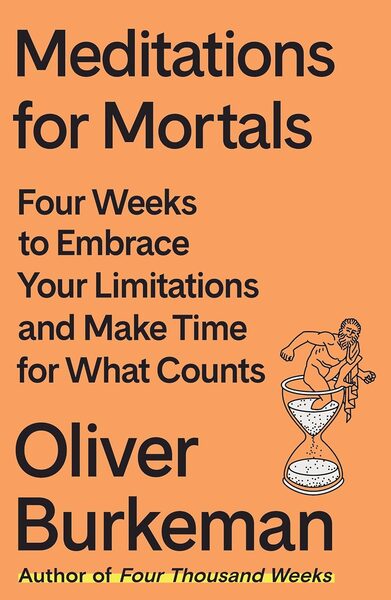

Meditations for Mortals: Four Weeks to Embrace Your Limitations and Make Time for What Counts is Oliver Burkeman’s follow-up to Four Thousand Weeks, and it keeps pushing in the same useful direction: stop fantasizing about becoming an infinitely efficient person and start building a decent life inside the messy limits of being human. That sounds obvious until you notice how much modern self-help, productivity culture, and even ordinary work habits are built on the opposite assumption. Most of us still act as if the breakthrough is one better system away. Burkeman’s argument is that the breakthrough often comes from dropping the fantasy itself.
Book cover image © publisher/rights holder. Used for review/identification. Source: Amazon product cover image.
TL;DR
Meditations for Mortals is a smart, calming, anti-hustle book for people who are tired of treating life like an inbox that might finally hit zero. Burkeman argues for what he calls a more grounded way of living: accepting finitude, embracing imperfection, and acting on what matters anyway. The book is strongest when it punctures the fantasy that better planning, more discipline, or the right app will remove the friction of being alive. Instead, it offers a saner framework: choose, commit, tolerate discomfort, and stop waiting for perfect readiness. It is less a conventional step-by-step system than a sequence of perspective corrections. That makes it excellent for thoughtful readers who feel overextended, but slightly frustrating for people who want a rigid implementation playbook with worksheets and measurable milestones.
Who it’s for
- Readers who liked Four Thousand Weeks and want a more reflective, practical companion rather than a reheated sequel.
- People who feel chronically behind, overcommitted, or weirdly disappointed by productivity advice that only makes them more self-conscious.
- Knowledge workers, founders, freelancers, writers, and parents who know life is finite but still keep behaving like they can optimize away every trade-off.
- Anyone drawn to philosophy, psychology, and behavioral insight packaged in plain, readable language.
Who should skip
- Readers who want a highly tactical system with templates, detailed routines, or a tight action framework like a habit manual.
- People looking for aggressive ambition, peak-performance rhetoric, or “10x your output” energy. This book is basically the antidote to that.
- Anyone who gets impatient with repetition in reflective nonfiction; Burkeman circles core ideas from different angles rather than charging through a linear model.
Key ideas
The core idea is that a meaningful life is not built after you eliminate uncertainty, anxiety, and incompleteness. It is built in the middle of them. Burkeman’s target is the deeply familiar habit of postponing real life until you feel more prepared, more in control, or more caught up. He argues that this posture quietly wastes years because the state of total readiness never arrives. There is always more email, more chaos, more laundry, more ambiguity, more things you could improve first. If you wait for the friction to disappear, you wait forever.
That is where his broader theme of imperfectionism lands. The point is not to lower standards out of laziness. The point is to stop making impossible standards the condition for beginning. Burkeman keeps returning to the fact that our time, attention, and energy are finite, and that finitude is not a glitch to solve. It is the basic structure of a real human life. Once you stop fighting that fact, choices become clearer. You can disappoint the fantasy version of yourself and become more loyal to the actual life in front of you.
Another strong thread in the book is the distinction between abstract control and lived commitment. Modern life trains people to keep options open, maintain flexibility, and delay commitment until conditions look ideal. Burkeman’s counterpoint is that much of what makes life meaningful only appears after commitment: relationships, craft, parenthood, creative work, long projects, communities, even decent routines. You do not get certainty first and then commit. Usually you commit first and discover meaning from inside the commitment.
The book also pushes against the constant self-observation that infects a lot of self-improvement culture. You can spend so much time monitoring productivity, optimizing systems, and evaluating yourself that you stop participating fully in your own life. Burkeman is good on this. He treats over-management as another way of staying at a distance. Sometimes the healthier move is to stop auditing the process and do the thing badly, awkwardly, or before you feel spiritually aligned with it.
What it gets right
The biggest thing this book gets right is emotional accuracy. It understands the actual texture of modern overwhelm better than most productivity or “intentional living” books. The problem is rarely lack of information. Most people already know they should focus, say no more often, use their phone less, and make time for relationships. What they lack is permission to stop expecting those choices to feel clean, complete, and conflict-free. Burkeman offers that permission without turning soft or vague.
It also gets the tone right. He is skeptical without being cynical, philosophical without drifting into fog, and practical without pretending life is a machine. That combination matters. A lot of books in this lane either become smug minimalism for privileged readers or collapse into bland reassurance. Meditations for Mortals mostly avoids both traps. It says: yes, life is limited; yes, many tensions are permanent; yes, you still need to act. That lands harder than another lecture about morning routines.
Another strength is how well the book reframes discomfort. Burkeman keeps reminding the reader that many worthwhile actions feel like friction at the point of performance. Writing is uncomfortable. Having a difficult conversation is uncomfortable. Starting before you feel ready is uncomfortable. Parenting well is uncomfortable. Trying to remove all discomfort before action is just another avoidance strategy dressed up as preparation. That is one of the most durable insights in the book because it applies far beyond time management.
Finally, the book has re-read value. You do not need to absorb every chapter as a grand theory. It works well in fragments. You can return to a chapter when you are procrastinating, overcommitting, people-pleasing, or fantasizing about a future version of yourself who has finally become frictionless. In that sense, the title fits. It really does read more like a set of meditations than a conventional business or productivity book.
What it gets wrong or where it underserves the reader
The main limitation is that the book’s strength is also its weakness: it is more corrective than procedural. If you are the kind of reader who finishes a book wanting a precise implementation map for Monday morning, you may feel a little underfed. Burkeman gives you a better lens, but not always a detailed operating manual. That is fine if you mainly need a mindset reset; it is less satisfying if you need a harder scaffold for changing behavior under pressure.
There is also some repetition. Burkeman revisits his central themes from multiple angles, which suits the reflective format, but a skeptical reader could reasonably say the book occasionally restates its thesis with new examples rather than building a sharper argument. I do not think that ruins it, but it does mean the book is better experienced slowly than binged in a “finish the framework” mode.
The other caveat is audience fit. His approach works best for readers who have at least some control over how they allocate attention. If your life is dominated by acute financial strain, rigid shift work, or unstable circumstances, a philosophy of choosing what matters may feel true but not immediately actionable. That is not really a flaw in the ideas, but it does affect how directly useful the book feels in different situations.
Practical takeaways
- Stop treating backlog elimination as the prerequisite for starting the work or life that matters. The backlog will mutate forever.
- Assume meaningful choices involve loss. If saying yes to one thing closes off others, that is not failure; that is what choosing is.
- Expect discomfort at the front edge of action instead of reading discomfort as a sign you picked the wrong thing.
- Commit in concrete ways: a calendar block, a recurring practice, a conversation, a draft, a booking, a promise. Abstractions do not change your life.
- Measure a good day less by total completion and more by whether you gave real attention to something that counts.
- Use the book as a perspective reset, not another self-improvement trophy. One honest adjustment beats twenty highlighted passages.
If you buy into Burkeman’s argument, the practical result is not “do less” in a lazy sense. It is “stop wasting energy on fantasies of total control.” That often leads to better action, not less action. You become more willing to begin before clarity is perfect, more realistic about trade-offs, and less seduced by systems that promise to remove the human condition. That is a strong trade.
Browse hardcover and paperback editions on Amazon
See Kindle pricing and availability
Compare audiobook options on Amazon
Similar books
If this one clicks, Four Thousand Weeks is the obvious companion, though it is broader and a touch more philosophical. Essentialism is stronger if your main struggle is overcommitment and saying no. Deep Work is better if you want a more forceful case for uninterrupted concentration. The Antidote, Burkeman’s earlier book, is worth a look if you like his resistance to positivity theater and his preference for reality over motivational fluff. Meditations for Mortals sits in a useful niche: humane, intelligent, and practical enough to change behavior without pretending to solve life.
Sources
- Oliver Burkeman, Meditations for Mortals: Four Weeks to Embrace Your Limitations and Make Time for What Counts.
- Amazon listing and edition details: product page used for edition and cover reference.
- Macmillan catalog page: publisher page for official description and publisher metadata.
- Penguin Random House author page: author bibliography and title listing.
FTC disclosure: This article contains affiliate links. If you buy through them, Must Grab That may earn a commission at no extra cost to you.