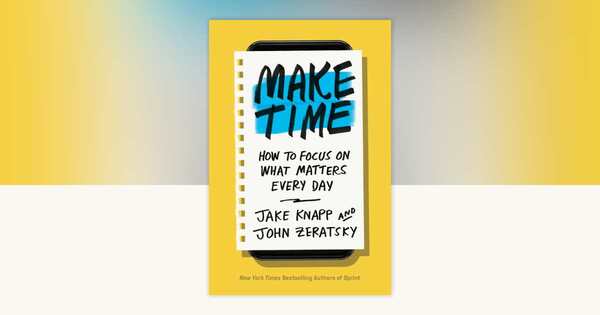

Make Time: How to Focus on What Matters Every Day is one of the more useful productivity books for people who are tired of being “busy” without feeling in control. Jake Knapp and John Zeratsky do not promise a perfect morning routine, a color-coded life, or a superhuman work ethic. Their pitch is simpler: pick what matters today, protect attention, manage energy, and make a few repeatable changes that reduce distraction. That sounds basic, but the book works because it is grounded in daily design rather than abstract motivation.
TL;DR
Make Time is worth reading if you feel like your day gets eaten by email, feeds, meetings, and low-value admin. Its strongest idea is not “do more,” but “decide what deserves your best attention, then design the day so you actually give it that attention.” The authors package that into a four-part framework: Highlight, Laser, Energize, and Reflect. The advice is practical, modular, and easy to test. The downside is that the book sometimes feels intentionally lightweight; if you want deep psychology, hard data on every tactic, or a system built for chaotic family or shift-work realities, it can feel a bit clean and idealized. But for knowledge workers, creators, founders, students, and anyone feeling digitally scattered, it is one of the more usable books in the category.
Who it’s for
- People who have a full calendar but still end most days wondering what they actually moved forward.
- Readers who like practical behavior design more than motivational speeches.
- Knowledge workers, freelancers, students, and creators trying to protect focused work.
- Anyone who wants a productivity book that is friendly, readable, and easy to revisit.
Who should skip
- Readers who want a deeply academic productivity book with heavy citations and dense research discussion.
- People whose main constraints are structural rather than attentional, such as zero schedule control or severe caregiving overload.
- Anyone who already has a strong daily planning system and mainly wants advanced project management, not focus habits.
Key ideas
The core framework is simple enough to remember without turning into slogans you instantly forget. Highlight means choosing one thing that would make the day feel meaningful or satisfying if it got real attention. Laser is about defending focus by reducing reactive inputs and friction. Energize covers the physical side of attention: sleep, movement, food, light, caffeine, and environment. Reflect means reviewing what worked, what did not, and which tactics are worth repeating.
That four-part model is the book’s biggest strength. It turns “be more productive” into something operational. You are not trying to optimize your entire life in one weekend. You are running small experiments. The authors are explicit about this: the book is a menu, not a doctrine. That matters because most people do not fail at habits because they lack information. They fail because the advice is too rigid, too vague, or too annoying to sustain. Make Time avoids a lot of that by treating behavior change like design: change the defaults, remove temptations, protect energy, notice outcomes.
A second useful idea is the enemy they call the “Busy Bandwagon” and the “Infinity Pools.” The Busy Bandwagon is modern work culture rewarding responsiveness, visible busyness, and constant inbox movement. Infinity Pools are the apps and media environments designed to never end: feeds, video queues, news refreshes, endless browser tabs. The book is at its best when it says the problem is not only personal discipline. The environment is engineered to capture you. That framing helps because it turns shame into strategy.
What it gets right
The book gets the scale right. It does not assume you need a life overhaul. Instead it offers small, stackable interventions: write tomorrow’s highlight, leave the phone in another room, block the morning for meaningful work, walk more, use caffeine more deliberately, stop depending on willpower alone. That is more credible than productivity books that pretend every reader can suddenly become a monk with Wi-Fi.
It also gets tone right. Knapp and Zeratsky are not scolding. They sound like product designers who noticed their own bad defaults and built better ones. That makes the advice easier to trust. Another thing the book gets right is connecting physical energy to mental performance. Too many books act like focus is a software problem only. Make Time keeps reminding the reader that sleep debt, sedentary days, low light, and constant snacking all influence attention quality.
Finally, the book is extremely reusable. You can read it once, grab three tactics, and come back later when work or life changes. That alone gives it better shelf life than many idea-heavy business books.
What it gets wrong or undersells
The main weakness is that some tactics are almost too neat. If you have kids, shift work, heavy customer-facing responsibilities, or limited control over your calendar, parts of the system can feel more aspirational than realistic. The authors acknowledge flexibility, but the examples still lean toward readers with some autonomy. The book also prefers breadth over depth. You get a lot of useful prompts and tactics, but not always the strongest possible evidence for why each one works.
There is also a subtle risk that readers turn the framework into another productivity hobby. Ironically, a book about focusing on what matters can become another thing you highlight, annotate, and talk about without changing your defaults. That is not the authors’ fault exactly, but it is worth saying: this book pays off only if you test the tactics in real days, not if you just enjoy agreeing with them.
Practical takeaways
- Choose one daily highlight before the day gets noisy.
- Put your most meaningful work in a protected block, ideally before reactive tasks multiply.
- Move distraction off the main path: log out, hide apps, move the phone, close tabs, remove defaults.
- Treat energy like part of the productivity system, not an afterthought.
- Run experiments for a week instead of hunting for the perfect forever routine.
- End the day with a quick reflection so your system evolves instead of resetting every Monday.
If you buy the book, the best move is not to “implement everything.” Pick one Highlight ritual, one Laser tactic, and one Energize habit. That is enough to see whether the framework helps. For most readers, the payoff comes from reducing cognitive drag, not maximizing output. You feel less scattered, less hijacked, and more deliberate. That is a better promise than becoming some flawless efficiency machine.
Browse hardcover and paperback editions on Amazon
See Kindle pricing and availability
Compare audiobook options on Amazon
Similar books
If you like the focus-on-what-matters angle here, Essentialism is better for deciding what to eliminate, while Deep Work is stronger on the value of uninterrupted concentration. Atomic Habits is better for behavior-change mechanics, and Four Thousand Weeks is better if you want a philosophical correction to the fantasy of total life optimization. Make Time sits in a useful middle ground: less abstract than Burkeman, less rigid than many business-productivity books, and more humane than hustle-culture systems.
Sources
- Jake Knapp and John Zeratsky, Make Time: How to Focus on What Matters Every Day.
- Penguin Random House book page: official description and edition details.
- Jake Knapp official page: author overview and endorsements.
FTC disclosure: This article contains affiliate links. If you buy through them, Must Grab That may earn a commission at no extra cost to you.