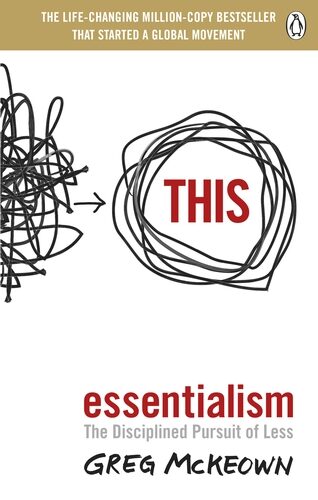

Essentialism: The Disciplined Pursuit of Less is Greg McKeown’s argument that the biggest productivity upgrade isn’t a better to‑do list — it’s a better selection system. If you regularly feel “busy but not effective,” this book is basically a permission slip (and a playbook) to do fewer things, on purpose, and to do the right things better.
TL;DR
- Essentialism is not minimalism and it’s not “doing less work.” It’s doing less, but better, by applying strict criteria to what you say yes to.
- The core enemy is default yes (to requests, meetings, projects, commitments) which quietly turns your life into other people’s priorities.
- The core skill is tradeoff thinking: you can do anything, but you can’t do everything — so choose deliberately, protect the choice, and execute with focus.
Amazon (affiliate) quick links:
Search Essentialism on Amazon ·
Search Effortless on Amazon ·
Search Deep Work on Amazon
What this book is really about (in plain English)
McKeown’s premise is simple: most people aren’t overwhelmed because they lack discipline; they’re overwhelmed because they don’t have a dependable way to decide what not to do. When your default response is “sure,” you slowly become a container for everyone else’s urgent requests — and then you wonder why you have no time for your own goals.
Essentialism is a mindset + operating system:
- Explore: create space to think, then evaluate opportunities with higher standards.
- Eliminate: say no gracefully but firmly; cut non-essentials; design boundaries.
- Execute: make the essential work easy to do (routines, buffers, constraints).
Who it’s for
- You say yes too quickly, then resent the commitment later.
- You’re good at work, so you get “rewarded” with more meetings, more projects, more random requests.
- You feel like you’re always moving, but the needle on what matters (health, family, craft, money goals) barely shifts.
- You’re in a leadership role and need a language for tradeoffs that doesn’t sound selfish.
Who should skip it
- You’re in a season where you truly have no discretion (e.g., acute caregiving, emergency workload, strict shift work). You can still benefit, but the leverage will be smaller and the tone may feel unrealistic.
- You want a tactical productivity book packed with apps, templates, and daily planners. Essentialism is more about decisions and boundaries than “life hacks.”
- You already have strong “no” skills and a ruthless prioritization culture around you; you may find some sections familiar.
Key ideas (the memorable ones)
1) If you don’t prioritise your life, someone else will
This is the emotional punch of the book. The world has infinite demands; your time and attention are finite. If you don’t actively choose, your calendar becomes a record of other people’s agendas.
2) Tradeoffs are real — pretending otherwise is expensive
One of the strongest reframes here is that everything is a tradeoff, whether you acknowledge it or not. Saying yes to a “small” extra request isn’t free; it’s paid for with deep work time, recovery time, relationships, or sleep.
3) Apply “strict criteria” to opportunities
McKeown pushes for a higher bar than typical prioritization. Not “Is this good?” but “Is this the right thing?” Not “Could I do this?” but “Is this worth the time it will steal from something else?”
4) The power of the graceful no
Essentialism is practical about refusal. The point isn’t to be rude; it’s to be clear. A vague yes creates more pain later. A respectful no creates a clean boundary now.
5) Protect the essential with systems (not willpower)
The last section is basically: stop relying on motivation. Build buffers, routines, and constraints so the important work happens even on messy weeks.
What it gets right
- It targets the real bottleneck: decision quality, not effort. Many people are already working hard — they’re just working hard on the wrong mix of things.
- It normalizes “less but better” as a virtue: especially helpful if you grew up equating busyness with worth.
- It’s a leadership book disguised as productivity: the ideas apply to teams (projects, meetings, goals) as much as to personal life.
- It’s compatible with modern work: Slack/pings/meetings make default-yes cultures worse; Essentialism gives a counterweight.
What it gets wrong (or at least oversimplifies)
- Power and constraints: it underplays how much “choice” depends on your role, finances, family situation, and workplace culture. Some people can’t just decline work without consequences.
- It can be read as permission to disengage: the immature version of Essentialism is “I’m too essentialist for that.” The mature version is “I’ll do fewer things, but I’ll do them excellently and reliably.”
- Some examples are a bit polished: the stories are motivating, but the messy middle (negotiating with a boss, managing stakeholders) often takes repeated attempts, not one brave conversation.
Practical takeaways (what to do this week)
1) Run a “default yes” audit
- List your current commitments (projects, meetings, recurring obligations).
- Mark each one: Hell yes / Maybe / No.
- Your goal isn’t to delete everything — it’s to identify the “Maybe” pile where renegotiation is possible.
2) Add a 24-hour rule to new commitments
If it’s not urgent, don’t decide on the spot. Try: “Let me check what I’m already committed to and get back to you tomorrow.” This single sentence breaks the reflex yes.
3) Create a “no” script you can reuse
Example: “I’m flattered you asked. I’m at capacity on my current priorities, so I can’t take this on. If helpful, I can point you to someone who might.” Reuse beats improvisation.
4) Put buffers in the calendar (like a professional)
- Meeting buffer: 10 minutes between calls.
- Weekly buffer: one “catch-up block” for overflow work.
- Recovery buffer: a real end to the day, so tomorrow isn’t punished for today’s chaos.
5) Define “the essential” for one area only
Pick one domain (health, money, family, work craft). Write a one-sentence essential intent, like: “My essential for health is lifting 3x/week and walking daily.” Then say no to anything that predictably breaks it.
Similar books (if you like this, try…)
- Deep Work (Cal Newport) — more tactical about focus and attention; a good companion for the Execute section.
- Four Thousand Weeks (Oliver Burkeman) — a philosophical (and often funny) take on time, finitude, and letting go.
- The One Thing (Gary Keller & Jay Papasan) — simpler and more sales-y, but very readable on focus and leverage.
- Indistractable (Nir Eyal) — more about internal triggers and attention control than prioritization, but overlaps.
Sources
- Publisher page (Virgin Books / Penguin UK): https://www.penguin.co.uk/category/books/418620/essentialism-by-mckeown-greg/9780753558690
- Author site (Greg McKeown): https://gregmckeown.com/
- Book overview on Amazon (for edition details and availability): https://www.amazon.com/Essentialism-Disciplined-Pursuit-Greg-McKeown/dp/0804137382
Final verdict
If you’re drowning in “good opportunities” and still not making progress on what matters, Essentialism is a reset. It won’t magically fix a toxic workplace, and it won’t replace hard conversations — but it gives you a clear philosophy and a repeatable decision filter. Read it once for the mindset, then re-read it when your calendar starts filling with other people’s priorities again.
FTC disclosure: This post contains Amazon affiliate links. If you click through and make a purchase, mustgrabthat.com may earn a small commission at no extra cost to you.